
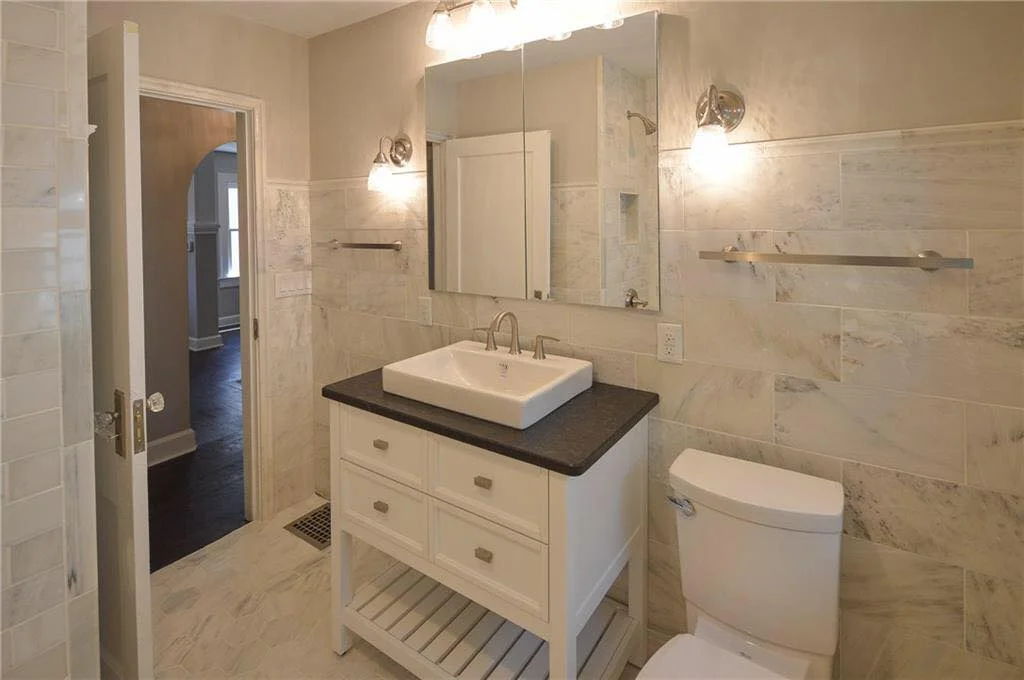
Replacing a vanity is one of the highest-impact, most manageable bathroom upgrades a Brownsburg homeowner can make. It's also one of the most frequently underestimated — both in scope and in what's typically found behind the old unit when it comes out.
What we cover:
Removal · Plumbing disconnection and reconnection · Leveling · Wall securing · Countertop fitting · Sink · Faucet · Finish work
Most projects begin with a site measurement to confirm rough-in plumbing locations, wall stud positions, and the exact space available. One remodeler handles the full installation — plumbing disconnection, vanity setting, countertop fitting, and reconnection all managed together so nothing leaks and nothing is left unfinished.
What a Vanity Installation in Brownsburg Actually Includes
A vanity installation in Brownsburg covers more than setting a cabinet in place. It includes shutting off and disconnecting existing plumbing, removing the old vanity and countertop, preparing the wall and floor surface, setting and leveling the new unit, and reconnecting the drain, supply lines, faucet, and any electrical connections for lighting or outlets. A professional installation ensures the vanity is plumb, secured to wall studs, properly sealed at the countertop, and leak-free at every connection. The result is a finished installation that holds up to daily use and does not create water damage problems behind the wall or under the cabinet.
- Plumbing disconnection and reconnection is part of every vanity swap — not an add-on
- Wall condition behind the old vanity often needs patching or repair before the new unit goes in
- Countertop templating and fitting is required when upgrading to a stone or custom top
Here's the part most homeowners don't anticipate: what's behind the old vanity. As Brownsburg custom bathroom renovation experts, we often find original builder-grade vanities installed against standard drywall with no moisture barrier. Once removed, water staining, softened drywall, and occasional mold growth are common, typically caused by long-term exposure from supply line condensation and sink splash migrating through unsealed wall connections. These issues must be corrected before installing a new vanity, or the same damage will repeat behind the new unit over time.
A complete vanity installation typically includes:
- Water shutoff and plumbing disconnection at supply valves and drain
- Removal and disposal of existing vanity, countertop, and sink
- Wall inspection and repair — drywall patching, moisture barrier installation if absent
- Floor surface leveling if the new vanity has legs or a freestanding base
- New vanity setting, shimming, and securing to wall studs — not drywall
- Countertop placement and securing — stone top templated and fitted to the wall
- Sink and drain connection
- Faucet installation and supply line connection
- Caulking at wall and countertop perimeter
- Final leak test at all connections before the shutoff valves are opened
How Brownsburg Homeowners Choose the Right Vanity for Their Bathroom
The number of vanity options available — sizes, styles, storage configurations, countertop materials — is legitimately overwhelming. The practical way through it is to start with constraints, not preferences.
Our starting point on every vanity project:
Measure the rough-in before selecting the unit. Everything else is secondary. The rough-in plumbing location determines how much flexibility exists in vanity sizing and placement. Supply lines and drain positions that don't align with the new cabinet require moving plumbing — which is a separate scope item that changes the project timeline and permit requirements. Confirming those dimensions before ordering prevents a vanity from arriving that can't be installed without additional work.
In Brownsburg neighborhoods like Arbor Hills and Stone Gate, master bathrooms frequently have enough wall space to upgrade from a single vanity to a double. It's one of the most requested changes in master bath projects in this area, and it makes a meaningful difference in both daily function and buyer appeal. The step most homeowners skip is confirming the rough-in plumbing spacing and available width before placing the order. A double vanity that arrives for a space where plumbing doesn't support it requires moving supply lines — work that should have been planned for before the vanity was ordered.
The practical checklist before selecting a vanity:
- What is the exact available width — measured from wall to wall, or wall to any obstacle?
- Where is the drain centered in the floor? That center point determines where a single-bowl vanity can sit.
- Where are the supply lines? Side-mounted supplies have different clearance requirements than center-mounted ones.
- What is the floor condition — tile, vinyl, or subfloor? Freestanding vanities require a level surface.
- Is the goal a standard depth, or is the bathroom tight enough to require a shallow-depth unit?
- What storage is needed — drawers, doors, or open shelving below?
What to Settle Before Your Vanity Installation Begins in Brownsburg
The most common vanity project delay in Brownsburg is a cabinet sitting in a garage waiting on a countertop that wasn't ordered at the same time. Stone countertop fabrication for vanities typically runs one to three weeks after templating. If the vanity is ordered without placing the countertop order simultaneously, the bathroom is out of service for that fabrication window after the old vanity is already gone.
The rule that prevents this:
Order the vanity and the countertop at the same time. Template the stone after the vanity is set. Have both ready to install in sequence without a gap.
What to have confirmed before installation day:
- Vanity selected and ordered with delivery date confirmed
- Countertop material selected and order placed — fabrication lead time tracked
- Faucet and drain selected — both need to be on hand before installation begins
- Rough-in plumbing dimensions confirmed against the new vanity specifications
- Wall condition assessed — if the existing drywall shows moisture damage, that repair needs to be scoped before the installation date
- Permit requirements confirmed — plumbing or electrical changes require permits through the Town of Brownsburg or Hendricks County Building Department
One additional item that often goes overlooked: the mirror or medicine cabinet. It's usually the last selection made and occasionally the last item to arrive. If it requires electrical work — a lighted mirror, a medicine cabinet with outlets — that wiring needs to happen before the wall is closed. Deciding on the mirror before installation day keeps that variable in the schedule rather than after it.
What Happens During a Vanity Installation in Brownsburg
A standard single vanity swap typically runs four to six hours on installation day. Double vanity upgrades, custom countertop fitting, and wall repair extend the timeline. Countertop fabrication runs one to three weeks before installation day — that lead time needs to be built into the schedule before the old vanity is removed.
Families in neighborhoods like Wynstone and Eagle Creek who need to plan around a bathroom being out of service get a clear timeline before demo is scheduled. Here's what installation day looks like from start to finish:
- First: Water shutoff and plumbing disconnection — supply lines and drain disconnected at the cabinet
- Next: Old vanity, countertop, and sink removed and disposed of
- Then: Wall inspection — any damage, moisture, or missing moisture barrier addressed before continuing
- Then: New vanity set in position, shimmed level, and secured to wall studs — not just drywall
- Then: Countertop placed, checked for level and fit against the wall, and secured
- Then: Sink set and drain connected
- Then: Faucet installed and supply lines connected
- Then: Caulking at wall perimeter and countertop edges
- Finally: All shutoff valves opened, connections checked, and a full leak test run before the project is called complete
On the leak test:
We don't leave until every connection has been checked under pressure. A slow supply line drip behind a vanity cabinet can cause significant water damage over months before it's noticed. The test at the end of installation day is what prevents that outcome.
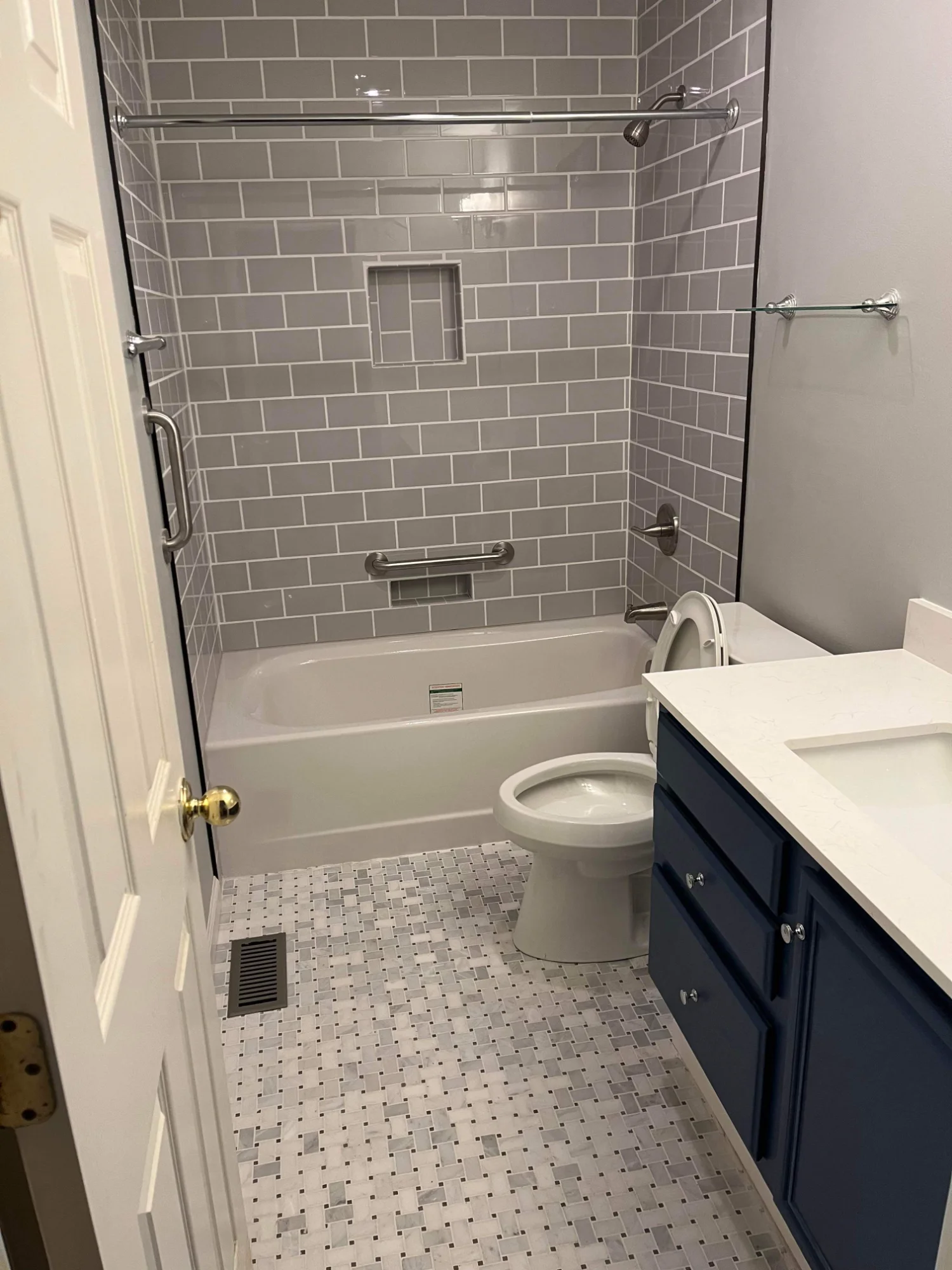
Custom vs. Stock Vanities — What Makes Sense for Brownsburg Homes
The custom vs. stock decision comes down to where the vanity is going and what the bathroom needs to accomplish — for daily use and for resale.
Our honest position:
Custom vanities return the most value in master bathrooms where fit, finish, and storage quality are visible and matter to buyers. Stock vanities are the right call for secondary bathrooms where function matters more than custom proportion and the renovation budget is better allocated to higher-impact upgrades elsewhere in the home.
In a master bathroom, a vanity built to the exact wall width — with integrated storage, a stone top, and a finish that coordinates with the tile and fixtures — looks and functions differently than a stock unit shimmed to fit a space it wasn't designed for. Buyers in the Hendricks County resale market notice that difference, and it shows up in how the master bath photographs and how buyers respond to it during showings.
In a secondary bathroom — a hall bath, a guest bath, a kids' bathroom — the calculus changes. A quality stock vanity installed correctly, with a stone top and proper hardware, performs well and photographs acceptably. The budget freed up by not going custom in that space is almost always better spent on tile, lighting, or the kitchen.
When custom makes sense:
- The wall width doesn't match any standard vanity size — filler strips and gaps are visible and unavoidable with stock
- The master bath is a primary selling point and the vanity is the focal element of the room
- Specific storage requirements — drawer configuration, pull-out organizers, integrated electrical — can't be met by stock options
- The bathroom is being finished to a level where stock product would be noticeably incongruous with everything else
When stock is the right call:
- Secondary bathroom where function and durability matter more than custom fit
- The rough-in plumbing aligns cleanly with standard vanity widths
- The renovation budget is better spent on tile, shower conversion, or another room
- Timeline is a priority — stock ships in days; custom takes weeks
The Most Common Vanity Installation Mistakes — and How to Avoid Them
Most of these mistakes are not complicated to prevent. They require doing a few things in the right order and checking a few things before the installation begins.
The most common vanity installation mistake in Brownsburg:
Failing to secure the cabinet to wall studs before setting the countertop. A vanity anchored only to drywall pulls away from the wall within months of daily use — Indiana's seasonal humidity causes drywall to expand and contract enough to break the fastener hold over time. The gap appears, the cabinet leans, and eventually the countertop cracks at the wall joint. We locate and hit studs on every installation. It's not a premium service — it's the correct way to install a vanity.
Other mistakes worth knowing before you start:
- Ordering the vanity without confirming rough-in dimensions — A vanity that arrives and can't be installed without moving plumbing is one of the most avoidable delays in bathroom work. Measure the drain center, confirm supply line positions, and check the cabinet specifications against those numbers before placing the order.
- Skipping wall repair behind the old unit — Whatever moisture damage exists behind the old vanity will continue to develop behind the new one if it isn't addressed. We inspect and repair before setting the new cabinet every time — it's not an upsell, it's a required step.
- Setting the countertop before the cabinet is confirmed level — A countertop installed on a cabinet that's even slightly out of level creates a persistent visual problem and can stress the countertop material over time. Level the cabinet first. Confirm it. Then set the top.
- Not ordering the countertop at the same time as the cabinet — The fabrication lead time is real. A vanity cabinet waiting two weeks for a stone top is two weeks of a bathroom out of service that could have been avoided with a simultaneous order.
- Skipping the final leak test — A connection that feels hand-tight is not the same as a connection that holds under pressure. Every supply line and drain connection gets a leak check before the project is called complete. Every time.