
We have rebuilt a lot of retaining walls in Brownsburg that were built by someone who skipped the drainage. From the front, they looked fine for two or three years. Then spring came with a heavy rain, the clay behind the wall got saturated, and the hydrostatic pressure — the weight of wet soil pushing against the back of the wall — did what it always does to walls without proper drainage. It pushed them over.
A retaining wall is not a landscaping project. It is a structural project. The difference between one that lasts twenty years and one that fails in three is almost entirely in what you cannot see once the wall is built — the drainage behind it.
This page covers retaining wall construction — block walls, poured concrete, timber, and the drainage systems that make all of them work in Brownsburg's clay-heavy soil.
What Retaining Wall Construction Covers for Brownsburg Homeowners
Retaining wall construction is not just for steep slopes. We see it in Brownsburg yards where the grade changes by two feet between the back yard and the neighbor's property. We see it along driveways where the edge of the pavement is starting to crack and separate. We see it in flower beds that have been slowly sliding downhill for five years.
Neighborhoods like Quail Creek and Stephens Creek have natural grade changes that make retaining walls a practical necessity — not an upgrade. When the soil shifts enough times, no amount of landscaping holds it.
Our honest take:
If you have a wall that is leaning, tipping, or starting to separate at the joints, it is not going to fix itself. It is going to keep moving until it fails completely. The question is whether you address it now at the repair or stabilization stage, or later at the full demolition and rebuild stage.
Retaining wall construction in Brownsburg covers:
- New wall construction — built from the footing up with proper drainage, gravel base, and correct material for the application
- Failed wall replacement — demo of what is there, assessment of why it failed, and a rebuild done right
- Tiered wall systems — multiple walls at different heights that manage a significant grade change in steps rather than one tall wall
- Drainage integration — perforated pipe, gravel backfill, and surface grading to manage water at and around the wall
- Walls adjacent to driveways, foundations, or structures — where the load on the wall requires engineering review
How to Build a Retaining Wall the Right Way — From Footing to Cap
Most retaining wall failures trace back to something that happened in the first hour of installation. Here is the correct sequence — and where shortcuts get taken.
- Excavate to the correct depth — the base course of a retaining wall sits below grade, not on top of the soil surface. How far below depends on wall height and local frost line.
- Compact a gravel base layer at least six inches deep before setting any block — this is the foundation of the wall and it has to be level and compacted before anything goes on top of it
- Set the first course of block or footing; check level in both directions — a first course that is not level means every course above it compounds the error
- Install perforated drain pipe directly behind the wall at the base of the first course — this is the step that most failed walls are missing
- Backfill with clean crushed gravel — not clay, not native Brownsburg soil, and not whatever was excavated to build the wall. Gravel drains freely. Clay holds water and pushes.
- Step back each course slightly as you go up — this batter angle leans the wall into the slope and dramatically increases its resistance to the pressure behind it
- Cap the wall and direct surface water away with proper grading so rain does not concentrate at the top of the wall and saturate the backfill from above
Hendricks County has a permit threshold for retaining walls, where walls over a certain height require both a permit and inspection. Residential and commercial construction in Hendricks County must account for these requirements from the start. We know the threshold, pull permits when required, and build to code from the first course up — not just the portions an inspector is likely to see.
Why Drainage Is the Most Important Part of Any Retaining Wall
We say this to every Brownsburg homeowner who calls about a retaining wall: the material does not matter as much as what is behind it.
You can build a wall out of the best concrete block available. If there is no drainage behind it, Brownsburg's clay soil is going to fill up with water every spring and push against that wall with thousands of pounds of hydrostatic pressure. The wall will move. It is not a question of if — it is a question of when.
Hydrostatic pressure explained simply:
Saturated clay soil is heavy. Very heavy. When it has nowhere to drain, that weight pushes outward against whatever is holding it back. A retaining wall without drainage is holding back not just the weight of the soil but also the weight of every drop of water trapped in that soil. That is why well-built walls have drainage and failed walls almost never do.
What proper drainage behind a retaining wall looks like:
- A perforated drain pipe running the length of the wall at the base, sloped to drain to daylight at one or both ends
- Clean crushed gravel — sometimes called drainage stone — backfilled behind the wall instead of native clay soil
- Geotextile fabric between the gravel and the native soil to prevent clay from migrating into the gravel over time and clogging it
- Surface grading at the top of the wall that directs rain away from the wall rather than into the backfill behind it
Brownsburg's flat terrain and heavy clay soil trap water fast. Spring snowmelt plus a few days of heavy rain is exactly the condition that destroys poorly drained retaining walls. We have seen it every year in this area. The walls that hold up are the ones with drainage. The ones that fail almost always have clay backfill and no pipe.
Common Retaining Wall Mistakes That Cause Early Failure
DIY retaining walls are common in newer Brownsburg subdivisions like Arbor Grove and Williams Park. Many of them look good when they are built. Most of them fail within three to five years. Here is why.
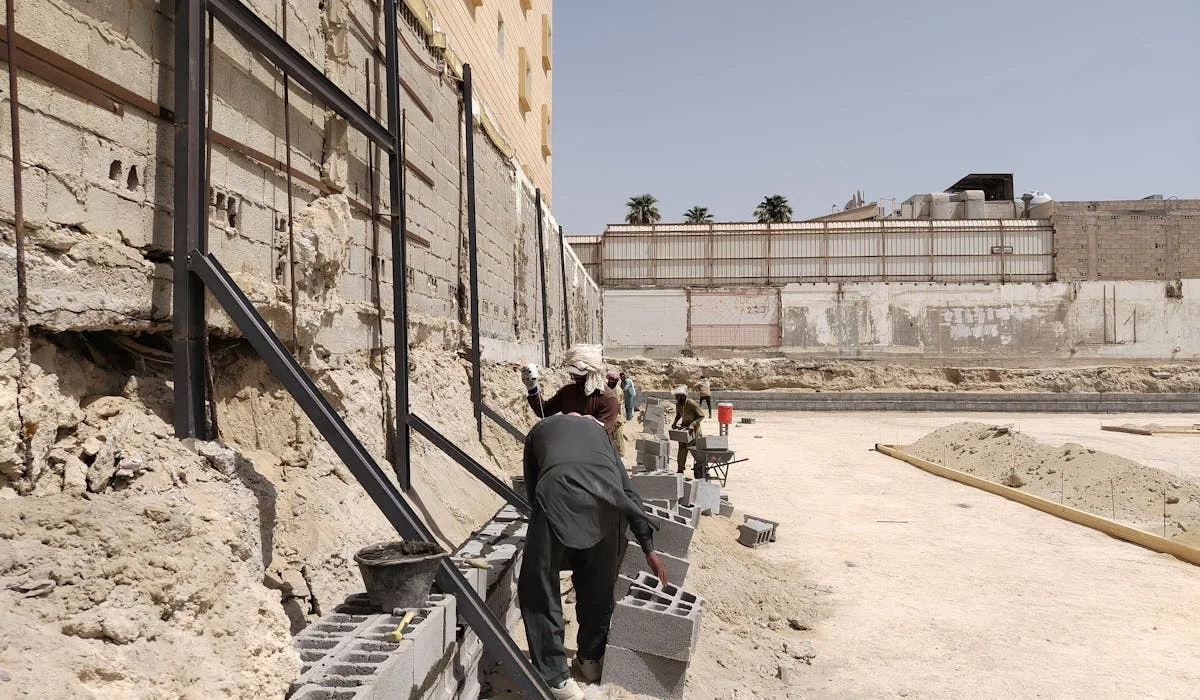
No gravel base — Setting blocks directly on compacted soil or worse, on uncompacted disturbed soil, creates a wall with an unstable foundation. The base settles unevenly and the wall follows. Every block above the settled section cracks at the joint.
No drain pipe — The single most common cause of retaining wall failure in Brownsburg. We have rebuilt walls that were installed by experienced-looking contractors and still had no drainage behind them. No drain pipe means hydrostatic pressure builds until the wall tips.
Clay used as backfill — Native Brownsburg clay dug out during excavation gets piled behind the wall because it is convenient and free. Clay holds water. It expands when wet and pushes against the wall. It is the wrong backfill for every retaining wall application.
Insufficient batter — Each course of a retaining wall should step back slightly from the one below it, leaning the wall into the slope. A wall built perfectly vertical has significantly less resistance to the pressure behind it than one with even a small batter angle. Most DIY walls are built vertical because it looks right. It is not.
Poor compaction of the gravel base — A gravel base that is not compacted properly allows the wall to settle unevenly. Uneven settling opens joints, cracks block, and eventually brings the wall down.
Footing not deep enough — In Indiana, walls that extend above a certain height need footings that account for frost depth. A wall built without adequate footing depth heaves during freeze-thaw cycles.
Poor block overlap — Adjacent courses of block need to be staggered so vertical joints never line up. Walls where the joints align have a structural weakness at every aligned joint.
Our advice to anyone getting quotes:
Ask every contractor you are considering what they use for backfill and where the drain pipe goes. If they cannot answer both questions clearly and specifically, they are not building a wall that will last in Brownsburg's soil conditions.
Best Retaining Wall Materials for Brownsburg Yards and Soil Conditions
The material choice matters — but less than the drainage and installation method. A cheap block installed correctly outlasts an expensive block installed wrong. That said, here is what we use and why.
Concrete segmental block is the right choice for most Brownsburg residential retaining walls. It is modular — meaning it can be cut and adjusted to fit curves and corners cleanly. It handles Indiana's freeze-thaw cycles well. It is available in multiple profiles and colors that match a variety of Brownsburg home styles. Most importantly, it is easy to install correctly — the engineering is built into the block system when you follow the manufacturer's installation guidelines.
Natural stone — fieldstone, limestone, or dry-stacked — looks exceptional in the right yard. It is also the most labor-intensive material and the hardest to install correctly at heights above two or three feet. Natural stone walls in Brownsburg look best as low decorative borders. For structural retaining applications at significant height, we almost always recommend concrete block.
Poured concrete is the strongest option for walls carrying significant loads — adjacent to driveways, near foundations, or in tiered systems where the walls are holding a lot of grade change. It requires forming, rebar, and proper curing. It is the right choice for applications where block would be undersized for the load.
Timber — railroad ties or landscape timbers — degrades faster in Indiana's wet springs than any other retaining wall material. We see timber walls that were installed in the early 2000s throughout Brownsburg, and almost all of them are rotting at the base. Timber has a place in low-load, decorative applications. For any structural retaining application, we recommend block or concrete.
How to Prepare Your Yard for Retaining Wall Construction
A few steps before we arrive make the project start on time and protect your yard from unnecessary damage during excavation and construction.
The step no one skips but everyone should do first:
Indiana 811 utility locate. Gas, electric, water, cable, and fiber lines run through rear and side yards in most established Brownsburg neighborhoods. Digging without a locate is illegal. It also finds lines in the worst possible way. We submit the locate request before we schedule excavation. Every time.
What to have done before construction begins:
- Indiana 811 utility locate completed — we handle this as part of project setup; confirm with us that it is done before the first shovel goes in
- Clear an access path for equipment — excavation and block delivery require access to the wall site; gate openings, overhead obstructions, and soft ground near the path all matter
- Move or flag irrigation lines — sprinkler heads and irrigation pipes are in the excavation zone on most Brownsburg yards; mark them before we arrive or have your irrigation company do it
- Relocate plants you want to keep — plants in the wall construction zone will not survive the excavation; move anything you value before work begins
- Confirm property line location — if the wall is near a property boundary, have the line confirmed before excavation begins; building a retaining wall on a neighbor's property is an expensive problem to fix