
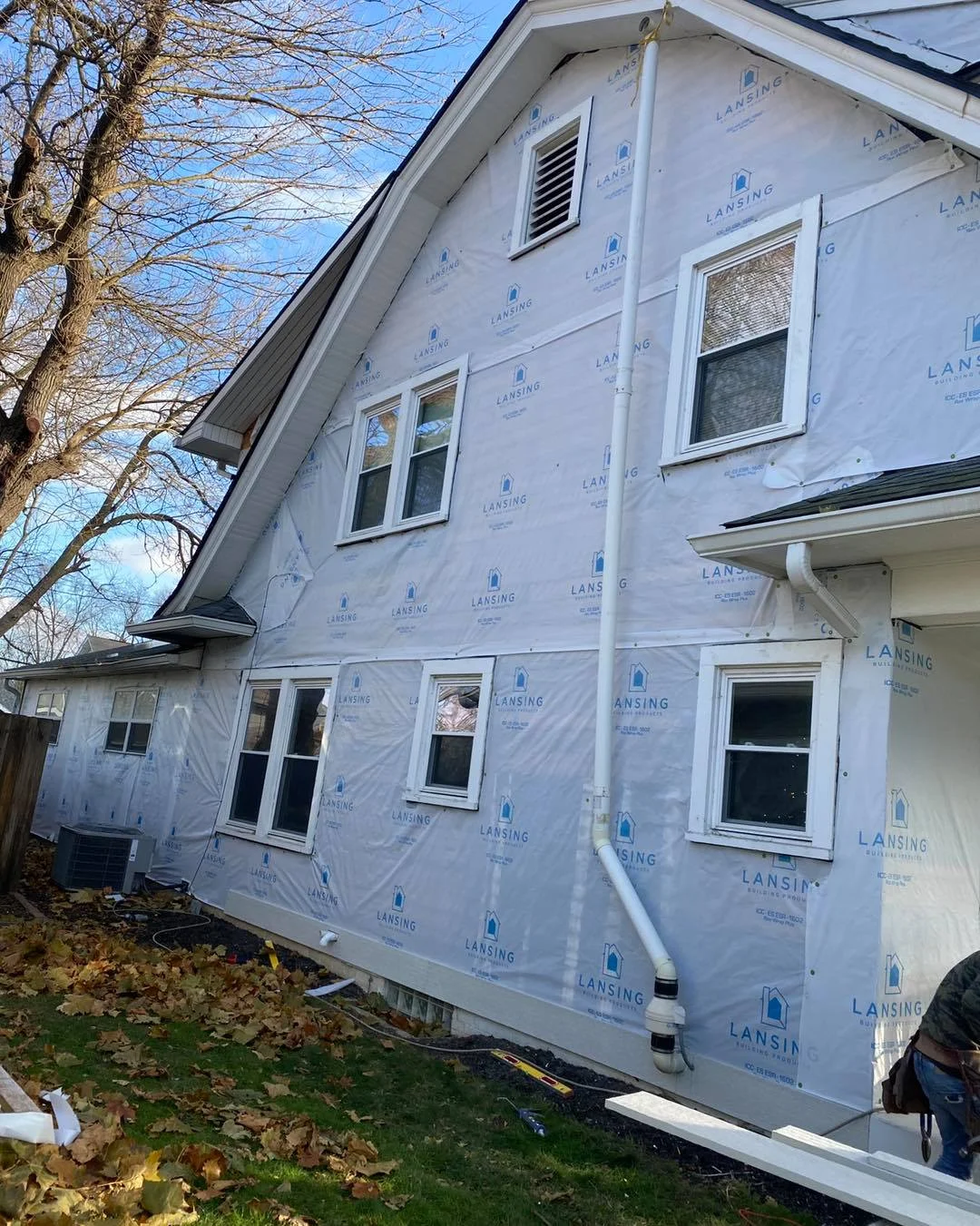
We have replaced a lot of siding in Brownsburg. A significant share of it failed not because the material was bad but because the installation behind it was. No house wrap. Nails driven too deep. Panels butted too tight with no room to expand. What looks fine on a 70-degree October day shows every flaw by February.
This page covers siding installation — vinyl, fiber cement, wood, and engineered siding for new builds and replacements. We handle material selection, permits, installation, and the finish details that make siding hold up through everything Hendricks County throws at it.
What Siding Installation Covers for Brownsburg Homeowners
Siding installation is not just for homes that look bad. Some of the worst-performing siding we have replaced looked perfectly fine from the street. The problems were behind the panels — water getting in through failed caulk joints, moisture trapped against the sheathing, rot developing where no one could see it.
Our honest take:
If your Brownsburg home was built in the early to mid-1990s and still has its original vinyl siding, you are probably within a few years of needing to make a decision. The material has lived a full Indiana life. The question is whether you wait for it to fail or stay ahead of it. Neighborhoods like Timber Creek and Country Brook are exactly where we see this playing out — homes that were built well, maintained well, but are simply at the end of what original-spec vinyl was designed to handle.
Siding installation in Brownsburg covers:
- Full siding replacement — removing everything down to the sheathing, inspecting for damage, and starting fresh with new material and moisture barrier
- New construction installation — siding on an addition or a newly built home where nothing existing is being removed
- Partial section repair — replacing storm-damaged sections, a single wall, or an area where rot has been found without doing the entire house
- Material upgrades — switching from original vinyl to fiber cement, engineered wood, or a higher-grade vinyl that performs better in Indiana's climate
- Trim, soffit, fascia, and J-channel — the finish details around windows, doors, and roofline that complete the weathertight envelope
How Siding Installation Works From First Measurement to Final Trim
Here is how a siding installation actually works in Brownsburg — from the first time we walk around your house to the day we leave the site clean:
- We measure your home and calculate material quantities — walls, gable ends, trim runs, and all openings accounted for before anything is ordered
- Old siding comes off and the exterior sheathing is inspected — this is where we find what was hidden; rot, moisture damage, and missing house wrap all get addressed before new siding goes on
- House wrap or moisture barrier goes across all exterior walls — this is the layer that protects the structure if water ever gets behind the siding
- Siding panels are cut, fitted, and fastened course by course from the bottom up — overlap, fastener placement, and expansion gaps all maintained throughout
- Trim, corners, soffits, and J-channel are finished around every window, door, and roofline transition
- Final walkthrough confirms alignment, caulking at all penetrations, and a weathertight seal at every joint
Indiana's weather windows matter more for siding than most homeowners realize. Brownsburg building and construction specialists schedule installs to avoid extended rain forecasts and plan around Brownsburg's spring storm season. A job that starts during a stable stretch of clear weather finishes cleaner than one that has to fight rain midway through panel installation.
Best Siding Materials for Brownsburg's Climate and Home Styles
This is where most homeowners spend the most time second-guessing themselves. There is no single right answer — but there is a right answer for your home, your exposure, and what you are willing to maintain.
Our opinion after years of siding work in Brownsburg:
Most homeowners who choose fiber cement never go back. It performs better in Indiana's temperature extremes, it looks better over time, and it does not telegraph every imperfection the way cheaper vinyl does. It costs more upfront. It earns that cost back over the life of the material.
Vinyl siding is the most common material in Brownsburg and for good reason — it is affordable, comes in a wide range of profiles and colors, and requires almost no maintenance. The difference between good vinyl and cheap vinyl is significant. Premium vinyl with a thicker wall and better UV protection holds its color and shape through Indiana's temperature swings. Thin, builder-grade vinyl fades, warps, and splits within a decade. If you are going vinyl, buy the better product.
Fiber cement siding — James Hardie and similar products — handles Brownsburg's climate extremes better than any other common siding material. It does not expand and contract with temperature the way vinyl does. It does not rot. It is not attractive to insects. It is heavier than vinyl, which means installation takes more labor, but it is also why it stays put on a wall through a hail storm that would dent or crack a thinner material. Brownsburg's temperature swings from below zero in winter to 90°F summers are exactly what fiber cement was designed for.
Engineered wood siding offers a natural wood appearance with better moisture resistance than real wood. It performs well in Brownsburg when installed correctly — which means a proper moisture barrier behind it and painted edges at every cut. Engineered wood that is installed without sealed edges or against standing water will fail earlier than it should.
Real wood siding is the highest-maintenance option in Indiana's climate. It needs to be painted or stained on a regular cycle and inspected annually for areas where moisture is getting in. It looks exceptional when it is maintained. It deteriorates quickly when it is not. Most Brownsburg homeowners choose this for specific aesthetic applications — accent walls, gable ends — rather than full house coverage.
How Long Siding Installation Takes and What Affects the Timeline
Most homeowners want a number. Here is the honest range: a standard Brownsburg home of around 1,500 square feet takes three to five days for a full siding replacement. Larger homes, more complex rooflines, and significant sheathing repair all add time.
Tear-off condition — If the old siding comes off cleanly and the sheathing underneath is dry and sound, the project moves fast. If we find rot, missing house wrap, or deteriorated sheathing — which is common in homes from the 1990s that have never been re-sided — that needs to be addressed before new siding goes on. We do not hide it. We show it to the homeowner and explain what we found.
Sheathing repairs — Every square foot of rotted or compromised sheathing adds material and time. We identify this during tear-off, not after. We tell you what we found the same day we find it.
Trim complexity — A home with multiple roofline transitions, dormers, bay windows, and decorative trim details takes longer to finish correctly than a clean rectangular house. The trim work is what separates a siding job that looks professional from one that looks like someone nailed up panels and called it done.
Our scheduling advice:
Peak siding season in Brownsburg runs late spring through early fall. If you want a summer install, call in late winter. Contractors book up fast between April and September. Waiting until July to start the conversation usually means an October start date. Getting on the schedule early also means your home is re-sided before Indiana's first hard freeze.

Signs Your Brownsburg Home Is Ready for New Siding
Some of these signs are obvious. Some are not. Here is what we look for when a Brownsburg homeowner calls and says they think it might be time.
Cracking, buckling, or warping panels — Siding that is visibly deformed has lost its structural integrity. It is no longer keeping water out the way it was designed to. Replace it.
Fading that will not come back — All siding fades eventually. If pressure washing does not restore the color or if the fading is severe and uneven, the material is done. Painting over it buys time but does not fix the underlying issue.
High energy bills that have gotten worse — Failing siding means failing insulation at the exterior wall. If your heating and cooling costs have climbed without a clear explanation, the exterior envelope is worth looking at.
Moisture in the walls — If you are finding soft spots in the wall, damp drywall, or musty smells near exterior walls, water is getting in somewhere. Siding failure is one of the most common causes. We find it during tear-off.
Storm damage — Hail and high winds are part of spring in Brownsburg. Neighborhoods like Wynbrooke and Quail Creek see frequent insurance-related siding claims after severe weather. A dent or crack in siding is not just cosmetic — it is an entry point for water. If your neighbors are getting new roofs after a storm, look at your siding too.
Our honest opinion on "just painting it":
We hear this regularly. A homeowner wants to refresh the look without replacing the siding. If the material is sound and the issue is purely cosmetic fading, painting is a reasonable option. If the siding is cracking, buckling, or showing signs of moisture intrusion behind it, painting over it is money spent on something that will need to come off anyway. We will tell you which situation you are in.
How to Prepare Your Home Before Siding Installation Begins
A few things done before the crew arrives make the project go faster and protect what you have already paid for in your yard and landscaping.
Most common day-one delay in Brownsburg:
Bushes and shrubs planted against the foundation that have not been trimmed back. We need clearance to work all the way down to the bottom course of siding. If plants are in the way, we have to work around them — which slows the job and risks damage to both the plant and the new siding.
What to have done before installation starts:
- Trim shrubs and bushes at least two feet away from all exterior walls — this is the single biggest prep step that homeowners skip
- Move outdoor furniture, grills, planters, and decorative items away from the house perimeter
- Secure or move pets — crews will be working around the full exterior of the house for several days
- Remove window AC units if possible — they create complication at the window trim and are easier to deal with if they are out of the way
- Check HOA requirements — Brownsburg communities like Arbor Grove and Prestwick may require architectural review and material approval before installation begins; confirm this before materials are ordered, not after they arrive