
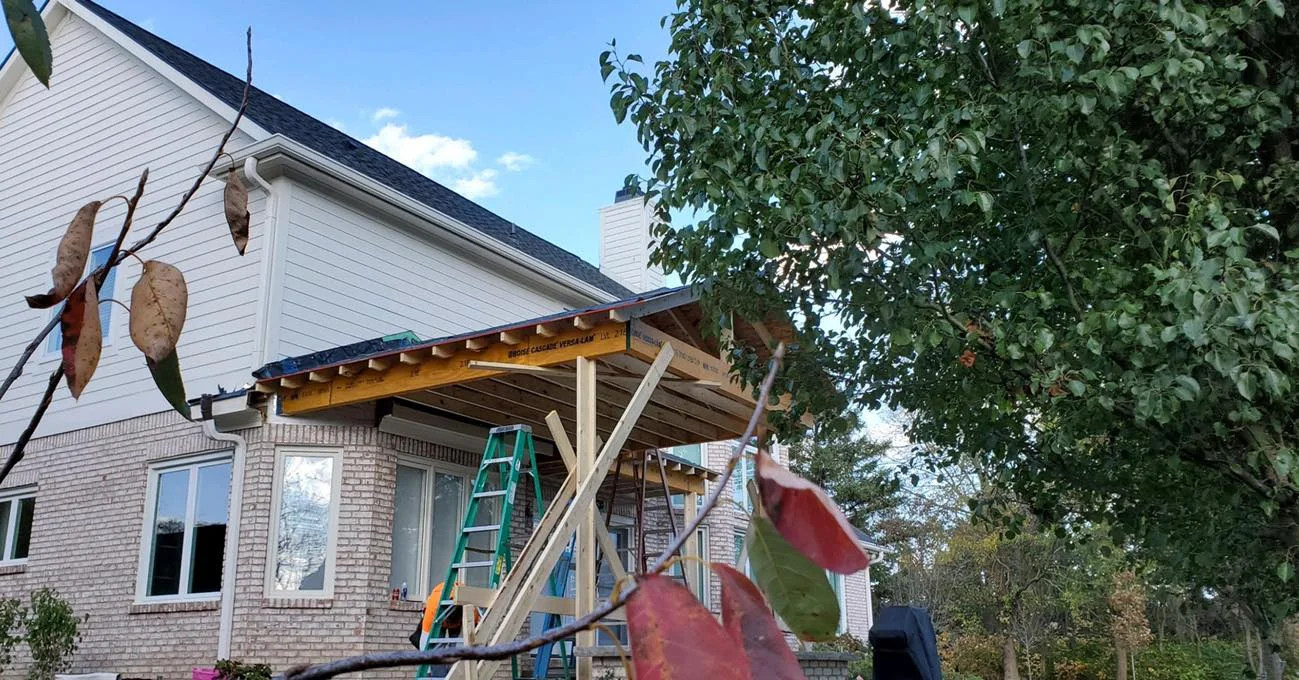
This page covers structural framing — wood framing, steel framing, load-bearing walls, and the lumber used to build them. We handle framing correctly, to code, and with the inspections to prove it.
What Structural Framing Is and Why It Matters for Your Build
Structural framing is the skeleton of a building. It is the system of wood or steel members that carries the weight of everything above. In Brownsburg, most homes use wood platform framing. Additions and commercial projects may use steel. A licensed remodeler ensures framing meets Indiana building code and passes inspection.
Structural framing covers:
- Load-bearing walls, beams, and headers
- Floor and ceiling joists and roof rafters
- Structural connections for additions and remodels
Here is the simplest way to think about it: framing is not cosmetic. You will never see it once the walls are closed. But every decision made at the framing stage affects everything you do see. A wall framed out of plumb makes cabinets hard to install. A header that is undersized causes the opening above it to sag over time. A missing connection at a beam can let a floor deflect under load.
Construction company services in Brownsburg Indiana must account for stresses created by Indiana's freeze-thaw cycles. A construction company in Brownsburg IN plans foundations, framing, and structural connections with that movement in mind. Foundations shift slightly through each winter, and framing that is not detailed for that movement loosens over time. In Brownsburg, proper construction company services in Brownsburg Indiana are not just about meeting code — they are about building structures that withstand full seasonal cycles for decades without premature failure.
Structural framing is needed for:
- New home construction from the ground up
- Room additions that attach to the existing home
- Open-concept conversions that remove load-bearing walls
- Window and door enlargements that require new headers
- Basement finishing that adds framed interior walls
- Any structural change that touches the load path of the building
How Structural Framing Works on a Brownsburg Remodel or New Build
Framing happens in a specific order. Understanding that order helps you know what to expect — and helps you spot a contractor who is cutting corners on sequence.
Here is how structural framing works step by step:
- Layout — the floor plan is marked on the slab or subfloor; wall positions, door openings, and window rough openings are all confirmed before the first plate is cut
- Bottom plates — pressure-treated lumber is fastened to the concrete slab or subfloor at every wall position
- Wall framing — studs are cut and assembled into wall sections; load-bearing walls get larger studs and doubled top plates
- Headers — structural members above every door and window opening carry the load around the opening; header size is determined by the span and the load above
- Raising walls — assembled wall sections are stood up, plumbed, and braced temporarily until sheathing locks everything in place
- Top plates — a second top plate ties adjacent walls together and helps distribute loads across the structure
- Floor and ceiling joists — horizontal framing members carry floor and ceiling loads between walls and beams
- Roof framing — rafters or engineered trusses carry roof loads down to the wall framing
- Sheathing — structural panels applied to the outside of the wall framing create a rigid diaphragm that resists racking and wind loads
Hendricks County requires a framing inspection before any walls are closed in on a permitted project. We schedule and manage that inspection. You do not have to track it separately.
Types of Structural Framing Used in Homes and Commercial Buildings
Not every framing system is right for every project. Here in Brownsburg, the framing type follows the project type.
Wood platform framing is what you will find in almost every Brownsburg subdivision — Williams Park, Arbor Grove, and the vast majority of homes built in Hendricks County over the past 30 years. It is efficient, well-understood by every trade in the area, and appropriate for standard residential spans and loads.
Post-and-beam framing uses larger structural members spaced farther apart. It is less common in standard residential builds but shows up in barns, open-plan additions, and homes where exposed structural wood is part of the design intent.
Light-gauge steel framing is increasingly common in commercial projects near Ronald Reagan Parkway and in tenant fit-outs where non-combustible construction is required. Steel does not rot, shrink, or warp — which matters in commercial applications where dimensional consistency is critical for finish systems.
How to match framing type to project:
- Standard home addition in a Brownsburg subdivision: wood platform framing
- Open-span commercial space or restaurant: light-gauge steel or engineered wood
- Garage or accessory structure with exposed framing: post-and-beam or wood platform depending on span
- Basement framing for a finished space: wood platform with pressure-treated bottom plates at the slab
How to Tell if a Wall or Structure Is Load-Bearing Before You Renovate
This is the question that comes before every open-concept conversion in Brownsburg — and the one where getting it wrong has real consequences. Removing a load-bearing wall without a proper beam and posts to replace the load path causes the structure above it to deflect, crack, and eventually fail.
The short answer:
You cannot tell by looking at it. A wall that carries the full weight of the second floor looks exactly like a wall that carries nothing. The only way to confirm is an on-site structural assessment.
That said, there are cues that indicate a wall is likely load-bearing:
- The wall runs perpendicular to the floor joists — load typically travels down through walls that cross the joist direction
- There is a beam or post in the basement or crawl space directly below the wall
- The wall is in the center of the house, running parallel to the ridge of the roof
- The wall is directly below second-floor framing in a two-story home
Many 1990s and early 2000s Brownsburg ranch homes have center walls that run the length of the house. These walls almost always carry load. We see homeowners who have heard otherwise — usually from someone who removed a wall in a similar-looking house and didn't have a problem. That is not a structural assessment. That is luck.
We assess every wall before demo is scheduled. No exceptions.
What Wood and Materials Are Used in Structural Framing
Most Brownsburg homes are framed with standard dimensional lumber — the same material that has been used in residential construction across Indiana for generations. Understanding what goes where helps you evaluate whether a contractor is specifying materials correctly.
SPF dimensional lumber — spruce, pine, and fir — is the standard for wall studs, top and bottom plates, and most framing members in residential construction. It is strong, widely available from Indiana suppliers, and meets Hendricks County code for standard residential applications.
LVL beams — laminated veneer lumber — are engineered wood products used for headers over large openings and main carrying beams in floors and roofs. They are stronger and more dimensionally stable than dimensional lumber for the same depth, which matters when a beam needs to carry significant load without excessive depth.
Engineered joists — I-joists and floor trusses — are used in floors and roofs where longer spans or tighter deflection limits are required. They are lighter than solid lumber at the same depth and do not crown or twist the way dimensional lumber can over time.
Pressure-treated lumber is required wherever wood is in contact with concrete or masonry — sill plates, bottom plates on slabs, and any framing in contact with the foundation. Standard dimensional lumber will rot at those contact points. Pressure-treated lumber will not.
Indiana lumber suppliers and Hendricks County code both influence which materials are specified on a given project. We use the right material for each application — not the cheapest available option that could technically pass inspection.
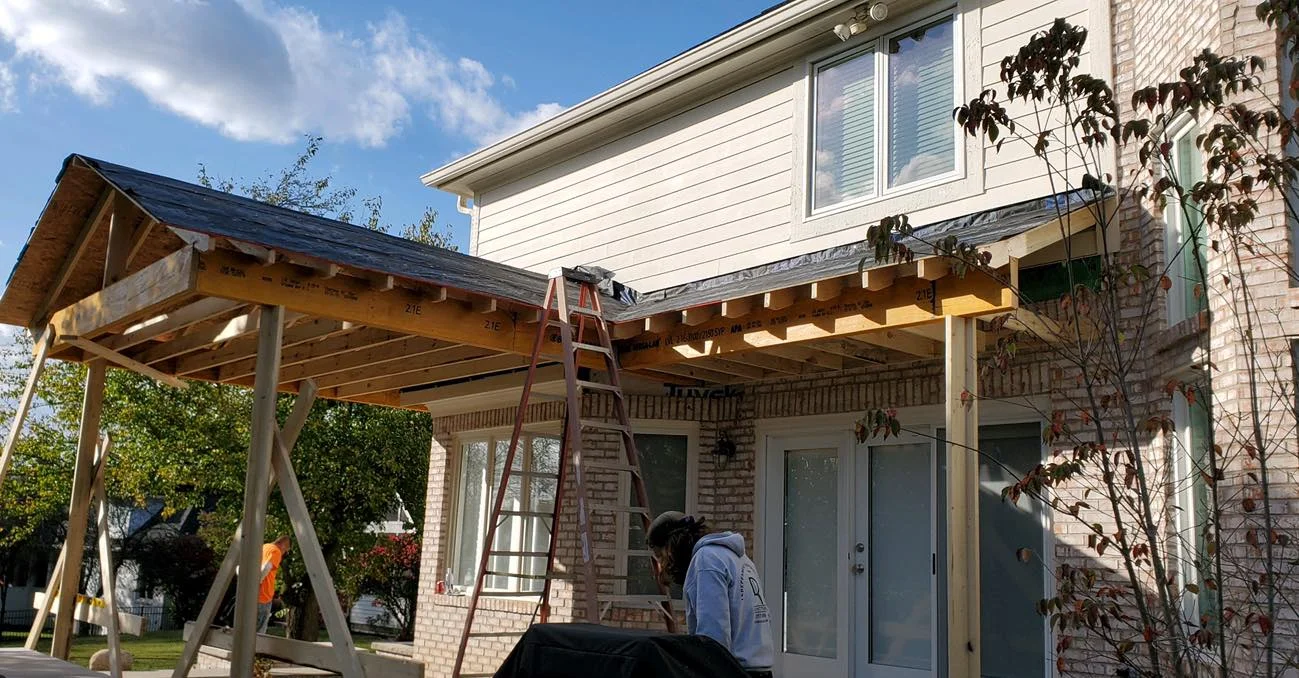
How to Prepare Your Home for a Structural Framing Project
Once a contract is signed, a few things on your end make the framing phase start smoothly and stay on schedule.
Timing matters in Brownsburg:
Additions with open exterior walls — where the exterior of the existing home is temporarily exposed during the framing tie-in — are best scheduled outside Indiana's winter months. A framing project that opens the building envelope in January adds weather risk that a spring or fall schedule avoids.
What to have ready before framing begins:
- Clear access to the work area — furniture, stored items, and personal belongings removed from the framing zone before the first day
- Utility shutoffs confirmed — know where your gas, water, and electrical shutoffs are; the crew may need them during the project
- Temporary living plan if the project affects primary living areas — framing is loud and dusty; knowing in advance which rooms will be affected helps the household plan around it
- Permits confirmed in hand — framing cannot legally begin on a permitted project until the permit is issued; we confirm this before scheduling the crew
- HOA notification if required — some Brownsburg subdivisions require notification or approval before exterior construction begins