
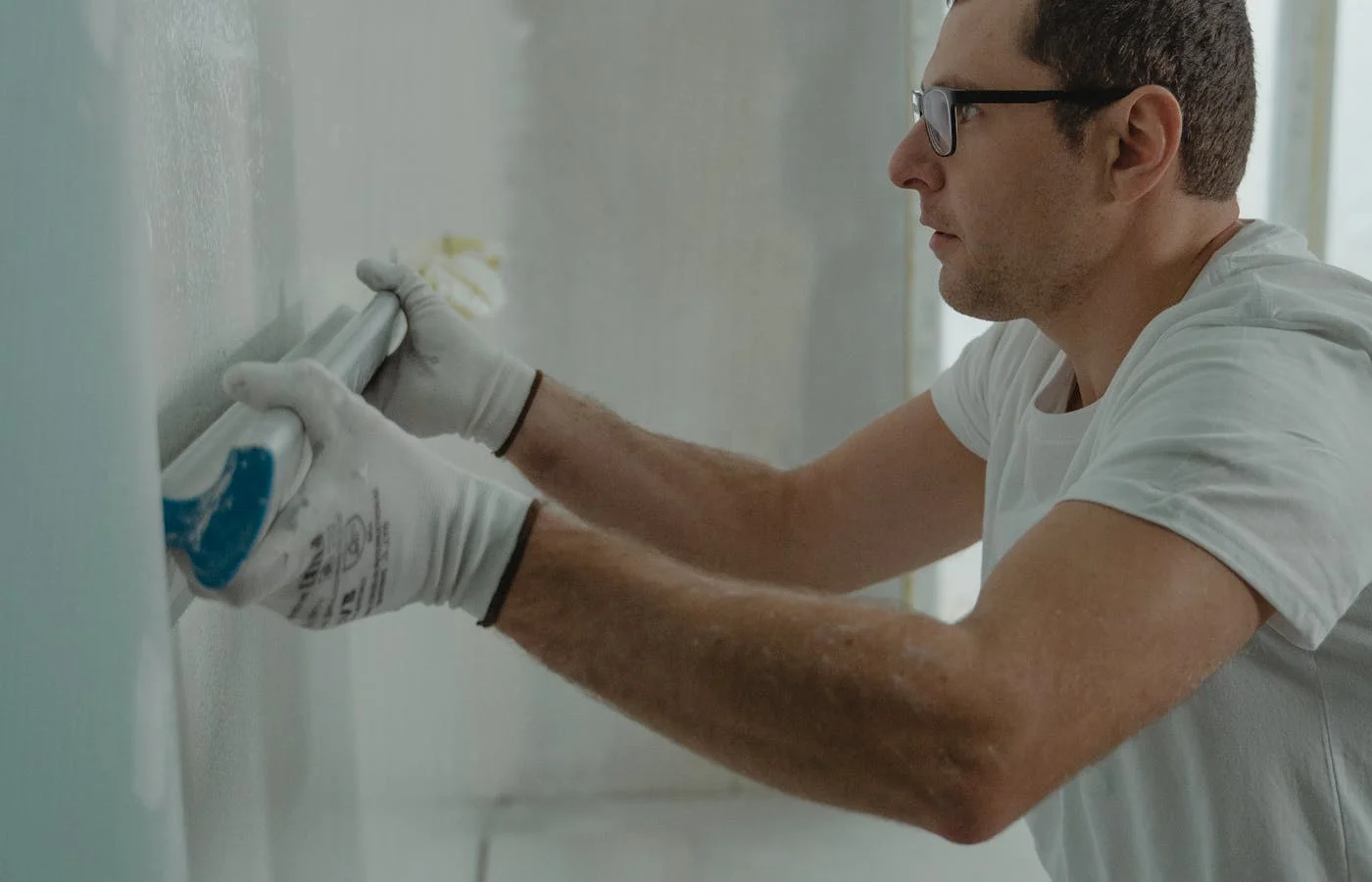
It's also the work that reveals itself most clearly when it isn't done right. Seams telegraph through paint. Screw pops appear after the first heating season. Texture mismatches on repaired sections read as patches from across the room under the right light.
The goal of professional drywall work is simple: the new work should disappear into the room. The seams should be invisible. The texture should match. The surface should be flat and paint-ready without any indication of where the old wall ended and the new work began.
What we cover:
Hanging · Taping · Mudding · Sanding · Texture matching · Finish-ready surfaces for new construction and repair work alike
Most projects begin with a site assessment to confirm scope, existing texture style, and the condition of surrounding walls and ceilings. One remodeler handles the full scope — framing inspection, hanging, finishing, and texture matching all managed together so the repair disappears and the new work is ready for paint.
What Drywall Installation and Repair in Brownsburg Actually Includes
Here are the most common drywall installation mistakes in Brownsburg homes — and what they tell you about the contractor who made them:
- Butt joints placed in high-visibility areas — butt joints should be staggered and kept away from the center of walls and ceilings where they are hardest to hide
- Screws set too deep or left proud — both create finishing problems that show through paint under raking light
- Skipping the second and third coats of joint compound — one coat of mud is never enough to create a flat, paint-ready surface
- Sanding too aggressively and cutting through the face paper — damaged paper creates raised fibers that telegraph through primer and paint
- Failing to match existing texture — a smooth patch on a knockdown wall reads as a repair from across the room
- Painting without a primer coat over fresh mud — unprimed joint compound absorbs paint unevenly and shows every seam
Drywall work is not screwing up sheets and slapping on mud. A properly finished surface requires board selection matched to the application, fastener spacing that doesn't create crowning at the panel edges, joint taping in the correct sequence, multiple coats of compound applied thin and feathered wide, sanding stages that flatten without cutting through the paper, and texture that matches the surrounding wall so precisely that the repair isn't visible after paint.
Contractor services in Brownsburg Indiana account for the fact that joint compound applied during high-humidity summer conditions dries differently than compound applied in dry winter air. A finisher who adjusts drying times and coat thickness for Indiana's seasonal conditions produces seams that stay flat through the full Hendricks County climate cycle — rather than cracking at the tape line after the first heating season.
A complete drywall project typically includes:
- Site assessment — scope confirmation, existing texture identification, framing condition review
- Board selection — standard, moisture-resistant, or fire-rated as appropriate for the application
- Hanging — butt joints staggered, fastener spacing correct, panels fitted tight to framing
- Taping — paper or mesh tape embedded in first coat of compound at all joints and corners
- Three-coat mud sequence — tape coat, fill coat, finish coat — each coat applied after the previous is fully dry and sanded
- Sanding — each coat sanded smooth without cutting through the face paper
- Texture matching — spray, knockdown, skip trowel, or orange peel applied to match surrounding walls
- Primer application before paint — fresh mud must be primed or it absorbs finish coats unevenly
How Brownsburg Homeowners Decide Between Drywall Repair and Full Replacement
The repair vs. replacement decision comes down to three questions: How extensive is the damage? What caused it? And is the underlying framing and moisture condition stable enough to support a patch?
The question we always ask first:
What caused the damage, and has that source been confirmed as resolved?
In Brownsburg neighborhoods like Arbor Hills and Stone Gate, water damage from roof leaks, ice dams, and plumbing failures is the most common reason homeowners call for drywall repair. The source of the moisture must be confirmed and corrected before any drywall work begins. Patching over active or recently dried moisture without confirming the source is resolved creates a mold condition behind the new wall that surfaces within one Indiana humidity season. We assess moisture status before we assess repair scope — every time.
When a patch is the right call:
- The damage is isolated to a small area with clean, dry edges
- The moisture source has been identified, repaired, and confirmed dry
- The surrounding framing is sound — no soft spots, no mold on the wood
- The existing texture is a style that can be matched reliably
- The damage is not at a structural element — no issues with corner bead, framing connections, or load paths
When full panel replacement makes more sense:
- The damage covers more than roughly a third of a panel — replacing the whole panel produces a flatter, more consistent finish than a large patch
- The drywall is soft, crumbling, or showing signs of long-term moisture exposure
- Mold is present on the drywall face or paper — contaminated drywall should be removed, not patched over
- The existing texture is too complex or inconsistent to match reliably at a patch boundary
- The repair is part of a larger project where adjacent panels are being opened for rough-in work anyway
What to Settle Before Drywall Work Begins in Brownsburg
The most common and most expensive sequencing mistake in Brownsburg remodel projects is drywall going up before rough-in inspections are passed. Once drywall is hung and taped, opening walls to satisfy a missed inspection means tearing out finished work that will need to be completely redone.
The correct sequence:
Rough-in work complete → rough-in inspections passed through Hendricks County → drywall hung. In that order. No exceptions on permitted projects.
Hendricks County requires rough-in inspections for electrical, plumbing, and mechanical work before drywall is hung on any permitted project in Brownsburg. A remodeler who sequences those inspections correctly keeps the project moving without the costly delay of opening freshly hung and taped walls to satisfy an inspector who hasn't yet signed off on what's behind them.
What to have confirmed before drywall work begins:
- All rough-in work complete and inspected — electrical, plumbing, and HVAC all signed off before a panel goes up
- Moisture source confirmed resolved on any water damage repair — no active moisture or recent wet-out behind the repair area
- Existing texture identified and documented — photos of the surrounding texture taken before demo is helpful for matching
- Board type confirmed for the application — moisture-resistant board in bathrooms and below-grade spaces, fire-rated board in garage-adjacent walls
- Paint and primer decisions confirmed — if the finisher is also priming, those products need to be on hand before the final sand coat is complete
- Scope boundaries confirmed — where the new drywall meets existing walls and ceilings needs to be discussed before hanging begins, especially on repair work where transitions will be visible
What Happens During a Drywall Installation or Repair Project in Brownsburg
Hanging a standard room runs one day. Finishing it correctly requires three to five days — and that timeline is not negotiable without compromising the quality of the finished surface. Each coat of joint compound must be fully dry before the next one goes on. Applying compound over compound that hasn't cured traps moisture that causes cracking at the tape line when the wall dries out through the first heating season.
Homeowners in neighborhoods like Wynstone and Eagle Creek who want a clear picture of the sequence and what each phase looks like get a day-by-day breakdown before work begins.
Here's what a typical drywall finishing project looks like phase by phase:
| Day | What's Happening |
|---|---|
| Day 1 | Hanging — panels hung, fastened at correct spacing, joints positioned to minimize butt joint visibility |
| Day 2 | Tape coat — paper tape embedded in first coat of compound at all flat joints, corner bead set, inside corners taped |
| Day 3 | Fill coat — second coat applied wider and thinner than the tape coat, feathered at the edges; any fastener dimples filled |
| Day 4 | Final coat — thin skim coat applied and feathered to a finish width; any repairs to ridges or voids from previous coats |
| Day 5 | Final sand — each joint area sanded smooth, face paper intact; surface inspected under raking light before texture is applied |
On drying time in Indiana:
Summer humidity in Brownsburg slows compound drying — a coat that feels dry on the surface may still be holding moisture inside. Winter heating dries compound faster than expected, which can cause the outer layer to skin over while the interior is still wet. We monitor conditions in the room and adjust the schedule accordingly rather than working on a fixed day count that doesn't account for what the room is actually doing.
Texture application follows the final sand. Getting texture right on a repair requires testing the spray pattern, pressure, and distance on a scrap panel before touching the wall — and matching the existing texture under the same light conditions that will reveal a mismatch after paint.
How to Know If Drywall Work Was Done Right in a Brownsburg Home
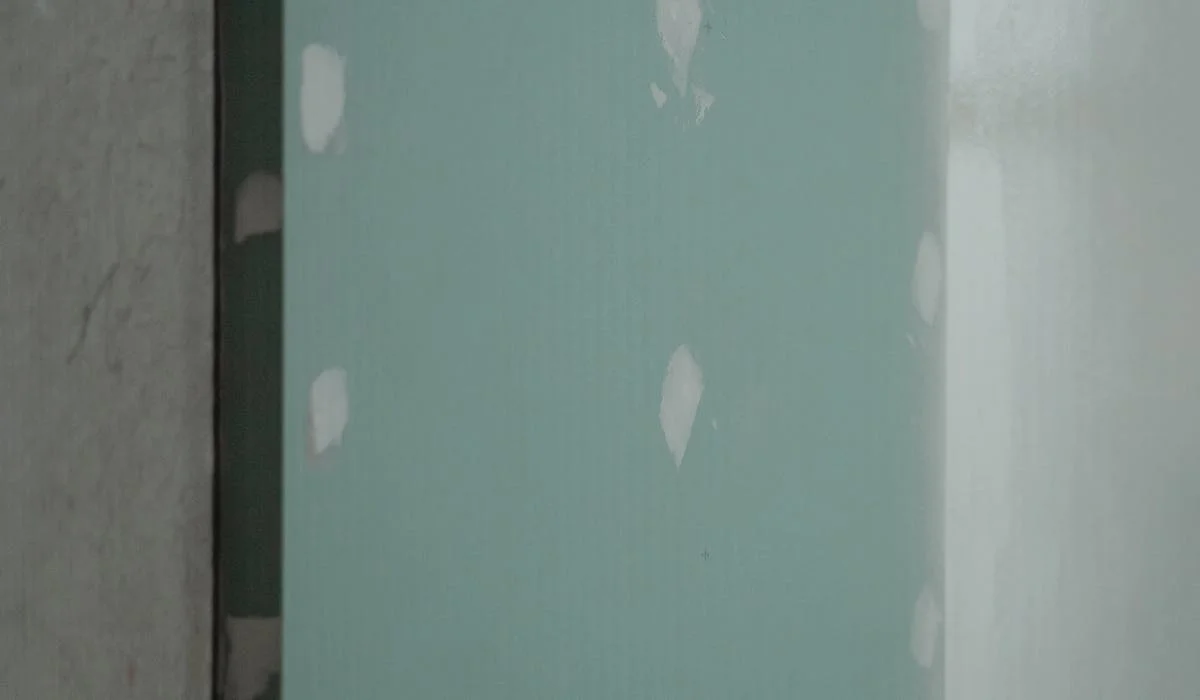
The raking light test is the most reliable quality check for drywall finishing. Holding a work light at a low angle across a finished wall — similar to how raking sunlight comes through a window in the morning — reveals every ridge, hollow, screw pop, and texture mismatch that disappears under overhead lighting. A professional finisher performs this check after the final sand coat and corrects anything visible before the surface is handed off for primer and paint.
How to do the test yourself: Stand at one end of a room and aim a bright work light or flashlight along the wall surface at a low angle — not toward the wall from the center of the room, but along it from one end. Any surface irregularity will cast a small shadow that makes it immediately visible. This is the check that separates a surface that's ready for paint from one that will reveal every seam after the first coat of color goes on.
What a properly finished surface looks like:
- Walls are flat and smooth under raking light — no ridges at joint lines, no hollow spots at the edges of the feathered mud
- Screw dimples are filled flush — not proud, not recessed, flush with the surrounding surface
- Tape lines are invisible — no ridge where the tape is, no hollow where the compound pulled back from the tape edge
- Texture matches the surrounding wall — same density, same pattern, same scale
- All corners are straight and clean — no waves in the corner bead, no mud buildup that rounds off a sharp corner
What indicates a rushed or incomplete finish:
- Ridges at joint lines visible under raking light — compound wasn't feathered wide enough or was applied too thick
- Screw pops within the first heating season — fasteners driven too deep, cutting through the core and losing holding strength
- Cracks at tape lines after the first winter — compound applied before previous coat was fully dry, trapping moisture that releases as the wall dries through the heating season
- Texture mismatch visible after paint — repair was not tested and matched before application
The Most Common Drywall Mistakes — and How to Avoid Them
Every mistake on this list is visible after paint goes on — which is exactly why none of them should be addressed after the fact. The time to catch drywall finishing problems is before primer, not after the homeowner has lived with them through one heating season and called back to ask what went wrong.
The most common drywall mistake in Brownsburg:
Rushing the mud drying schedule during summer remodels. Finishers working in Hendricks County homes during July and August sometimes apply second coats before the first coat has fully cured in higher ambient humidity. Compound that is not fully dry when the next coat goes on traps moisture that causes the finish to crack at the tape line after the first heating season shrinks the wall assembly back to its winter dimensions. The schedule cannot be fixed to a specific number of days — it has to be set by what the compound is actually doing in the room.
Other mistakes worth knowing before any drywall project starts:
- Butt joints in high-visibility locations — Butt joints — the factory-cut ends of drywall panels — are the hardest joints to finish invisibly because they don't have the tapered edge that factory edges do. Positioning butt joints in high-visibility wall centers, above doorways, or on ceilings where raking light hits them directly guarantees a visible seam. We position butt joints at the edges of fields and stagger them so they're never adjacent on the same line.
- Screws driven too deep — A screw driven deep enough to break the face paper has lost its holding strength and will pop out of the wall surface as the drywall expands and contracts through seasonal cycles. Fasteners should be driven to a slight dimple — enough to fill with compound, not enough to cut through the paper. We check fastener depth across every panel before taping begins.
- Single-coat finishing — One coat of joint compound is not enough to produce a flat, paint-ready surface. Three coats — tape, fill, and finish — is the minimum. Each coat applied thin, feathered wide, dried fully, and sanded before the next one goes on. There is no shortcut in this sequence that produces a good result.
- Skipping primer over fresh mud — Unprimed joint compound absorbs finish paint unevenly — the mud soaks up the first coat faster than the surrounding drywall paper, creating a dull spot at every seam and fastener location that shows clearly under raking light. A PVA primer coat over all fresh mud before finish paint is applied is a required step, not an optional one.
- Texture mismatch on repairs — Applying texture to a repaired area without testing and matching first produces a patch that is visible after paint regardless of how well the mud work was done underneath it. We test on scrap, match the surrounding texture, and apply under the same lighting conditions that will reveal a mismatch after the room is complete.