
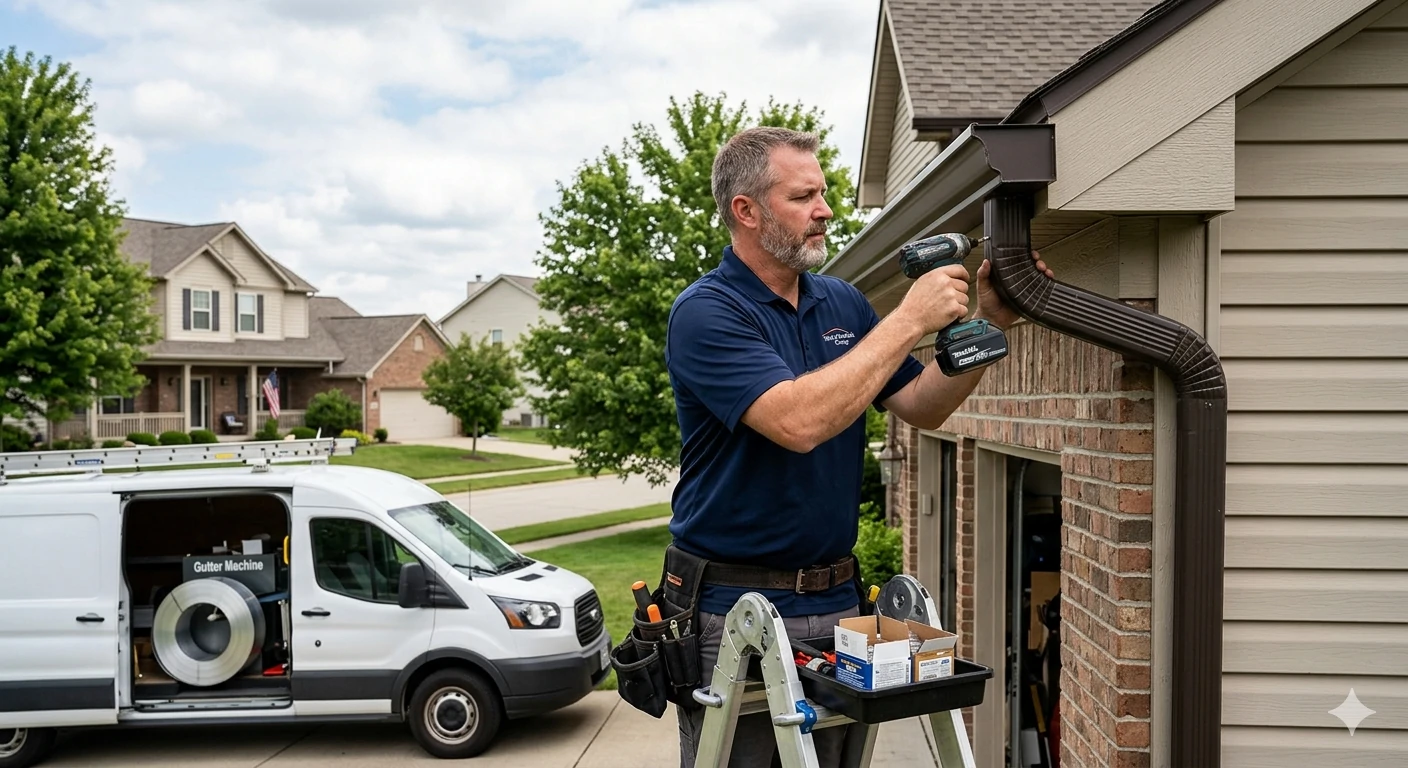
This page covers gutter installation: seamless aluminum gutters, sizing, downspout placement, hanger spacing, and what a complete professional installation involves. You'll learn how gutter installation works, when replacement is the right call, and how to protect your Brownsburg home from water damage at the roofline. A licensed Brownsburg remodeler installs gutters that are correctly sized, properly pitched, and built to handle Indiana's heaviest rain events without pulling away or overflowing.
How Does Gutter Installation Work in Brownsburg and What Size Do I Need?
- A licensed Brownsburg remodeler measures the full roofline perimeter and calculates drainage area for each gutter run to determine correct gutter width. 5-inch gutters handle standard residential rooflines; 6-inch gutters are required for steeper pitches or larger drainage areas common on Brownsburg two-story homes.
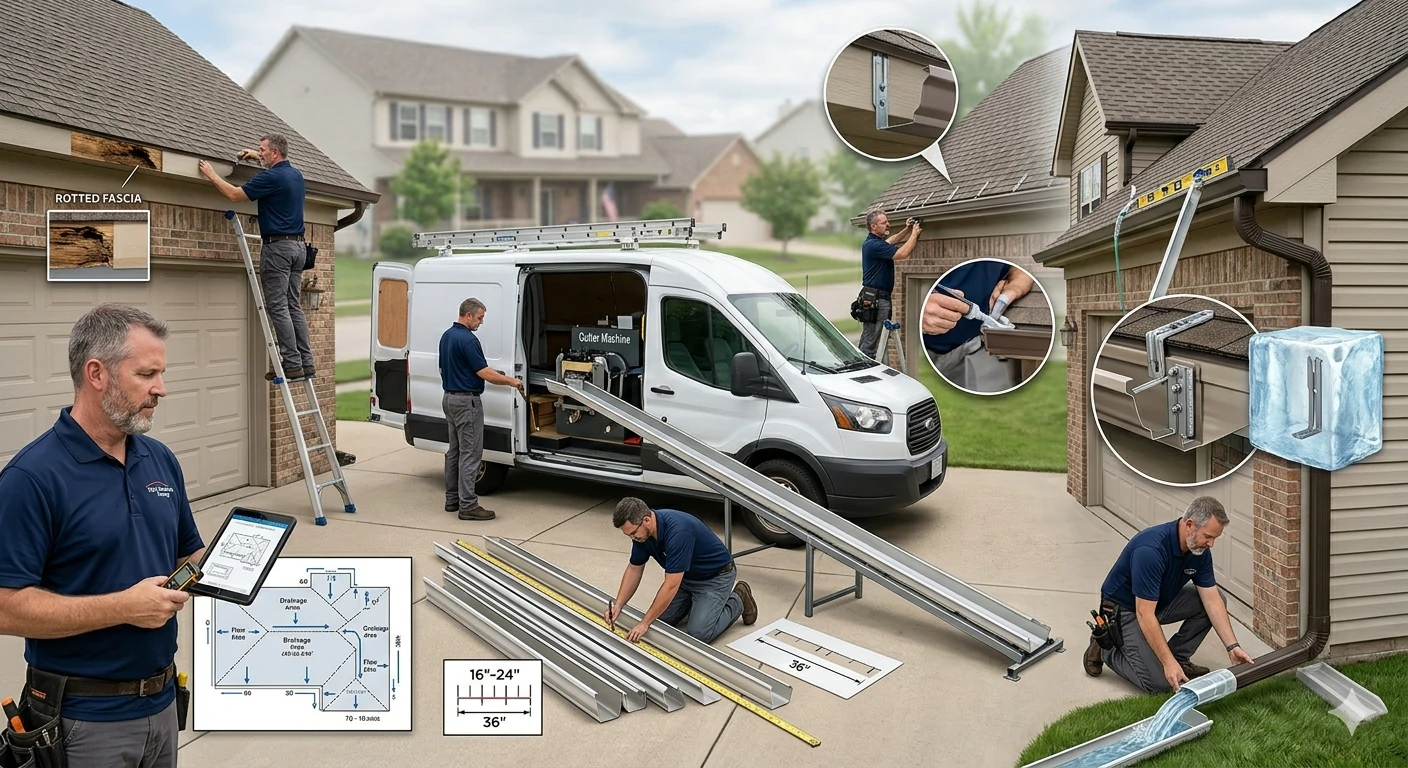
- Fascia condition is inspected — rotted or damaged fascia must be repaired before any gutter is attached, or the new system will pull away within one season.
- Hanger locations are marked at 16–24 inch intervals and pitch is calculated to move water toward each downspout at the correct slope. Gutters that appear level are actually pitched, and improper pitch causes standing water and mosquito breeding.
- Seamless gutter sections are fabricated on-site using a roll-forming machine. No seams between downspouts means no joints to leak, separate, or collect debris.
- Gutters are attached to fascia with hidden hangers, end caps and corners are sealed, and downspouts are positioned to discharge water at least 4–6 feet from the foundation.
- A final check confirms pitch, downspout flow, and that all corners and end caps are watertight before the crew leaves the site.
What Gutter Installation Covers for Brownsburg Homeowners
Professional gutter installation is not just hanging a channel at the roofline edge. A complete installation covers fascia inspection and repair, correct gutter width selection for the drainage area, on-site seamless fabrication, hidden hanger installation at the right spacing, pitch calculation for each run, end cap and corner sealing, downspout installation, extension placement, and a final flow check. Every part of the system works together, and cutting corners on any one of them leads to failure.
Brownsburg's clay-heavy soil has very low water absorption — and for residential roofing and gutter services in Hendricks County, that soil profile changes everything. Rain that overshoots or bypasses gutters during heavy Indiana spring storms saturates the soil directly against the foundation. That creates hydrostatic pressure against basement walls and slab edges — and it's the leading cause of water intrusion in Hendricks County residential basements and crawl spaces. Properly installed gutters are not a cosmetic upgrade. They are foundation protection, and residential roofing and gutter services in Hendricks County that treat them as an afterthought are missing the most important part of the job.
How Gutter Installation Works From Measurement to Final Downspout Placement
The process starts with a full roofline measurement and drainage area calculation for each run. Fascia is inspected and any rotted or damaged sections are repaired before a single hanger goes in. Hanger locations are then laid out at 16–24 inch intervals and pitch is planned so every run moves water efficiently toward a downspout.
Seamless gutter sections are fabricated on-site from a roll-forming machine — cut to the exact length of each run with no field joints between corners and downspouts. Gutters attach to the fascia with hidden hangers, end caps and corners are sealed, and downspouts are cut in and attached with extensions positioned for correct foundation clearance. A final flow check confirms pitch and confirms all terminations are watertight. Indiana's freeze-thaw cycle puts real stress on hanger connections. Ice weight in winter and thermal expansion through Indiana's seasonal temperature range cause improperly spaced hangers to pull away from the fascia. Discount installers use 36-inch hanger spacing to reduce material and labor time. We install at 16–24 inch intervals so the system holds through Brownsburg winters without pulling away.
Signs Your Brownsburg Home Needs New Gutters — Not Just a Cleaning
Cleaning and resealing make sense when gutters are structurally sound with isolated joint failures. Replacement is the right call when gutters are pulling away from the fascia along multiple runs, sagging visibly between hangers, showing widespread joint separation, have rust breakthrough on steel sections, or have been patched more than once without resolving overflow and fascia damage.
Brownsburg homes built in the late 1990s and early 2000s frequently have original sectional aluminum or vinyl gutters that are now 20–25 years old. Indiana's freeze-thaw cycle expands and contracts every joint in a sectional system annually. By this age, most of those systems have experienced enough joint cycle stress that resealing no longer produces a result that holds through a full Brownsburg storm season. These are legitimate full-replacement candidates — not cleaning projects.
Seamless vs. Sectional Gutters — Which Is Right for Brownsburg Homes
Sectional gutters have joints every 10–12 feet. Each joint is sealed with caulk and is the most common point of failure as the system ages. Seamless gutters are fabricated in single continuous runs on-site, with joints only at corners and downspouts. That eliminates the main source of gutter leaks and the debris accumulation that accelerates joint failure.
For Indiana's rain volume and freeze-thaw stress, seamless aluminum is the right long-term choice for virtually every Brownsburg home. Brownsburg's spring storm season delivers high-intensity rain events that overwhelm undersized or joint-compromised gutters fast. Seamless 6-inch gutters are increasingly the standard recommendation for two-story Brownsburg homes and homes with steep roof pitches — the higher volume capacity handles Indiana's peak rain events without the overflow that damages fascia, siding, and foundation landscaping.
What Affects Gutter Installation Scope and Timeline in Brownsburg
Several factors determine total scope and what appears in a complete bid. Total roofline linear footage, the number of corners and downspout locations, fascia condition and any repair needs, gutter width selection, whether a guard system is being added, and whether existing downspouts can be reused or need replacement all affect the final scope. Understanding these drivers helps you evaluate what's included in a bid versus what might appear as a change order after installation begins.
Brownsburg homes with heavily landscaped foundation beds — common in established neighborhoods like Eagle Pines and Quail Creek — require careful downspout extension planning. Water needs to route away from foundation plantings and existing grading without creating new drainage problems in adjacent yard areas. We plan downspout discharge locations as part of the installation design from the start, not as an afterthought once the downspout terminates wherever it lands.
How to Prepare Your Brownsburg Home for Gutter Installation
Before the crew arrives, trim back any overgrown shrubs or trees within ladder access distance of the roofline. Move outdoor furniture and decorative items away from the foundation perimeter and clear the driveway for the gutter fabrication truck. If your home has buried downspout drains, flag their locations so the crew can connect into them correctly rather than discharging onto the surface.
Brownsburg homes with underground downspout drainage connections are increasingly common in newer Hendricks County subdivisions where surface runoff restrictions require below-grade drainage systems. If your home has an underground system, confirm the location and condition of those drain connections before installation day. We connect new downspouts to existing underground systems correctly. Installers unfamiliar with local drainage requirements sometimes discharge onto the surface instead — negating the drainage system the homeowner already paid to install.
HOA note for Brownsburg gutter installation:
Some Brownsburg communities have exterior material or color approval requirements that cover gutter profile and finish. Confirm your HOA requirements before material is ordered. We flag this during the estimate phase so your installation proceeds without delays caused by color or profile restrictions discovered after fabrication.
Related Roofing Services in Brownsburg
Gutters are part of a complete roofing system. See our full Brownsburg roofing contractor services:
- Roof replacement — full tear-off, decking inspection, and new shingle installation
- Roof repair — leak diagnosis, flashing repair, and shingle replacement
- Storm damage roof repair — insurance documentation, adjuster support, and claim-backed repairs
- Metal roofing installation — long-lasting panels installed correctly for Indiana's climate