
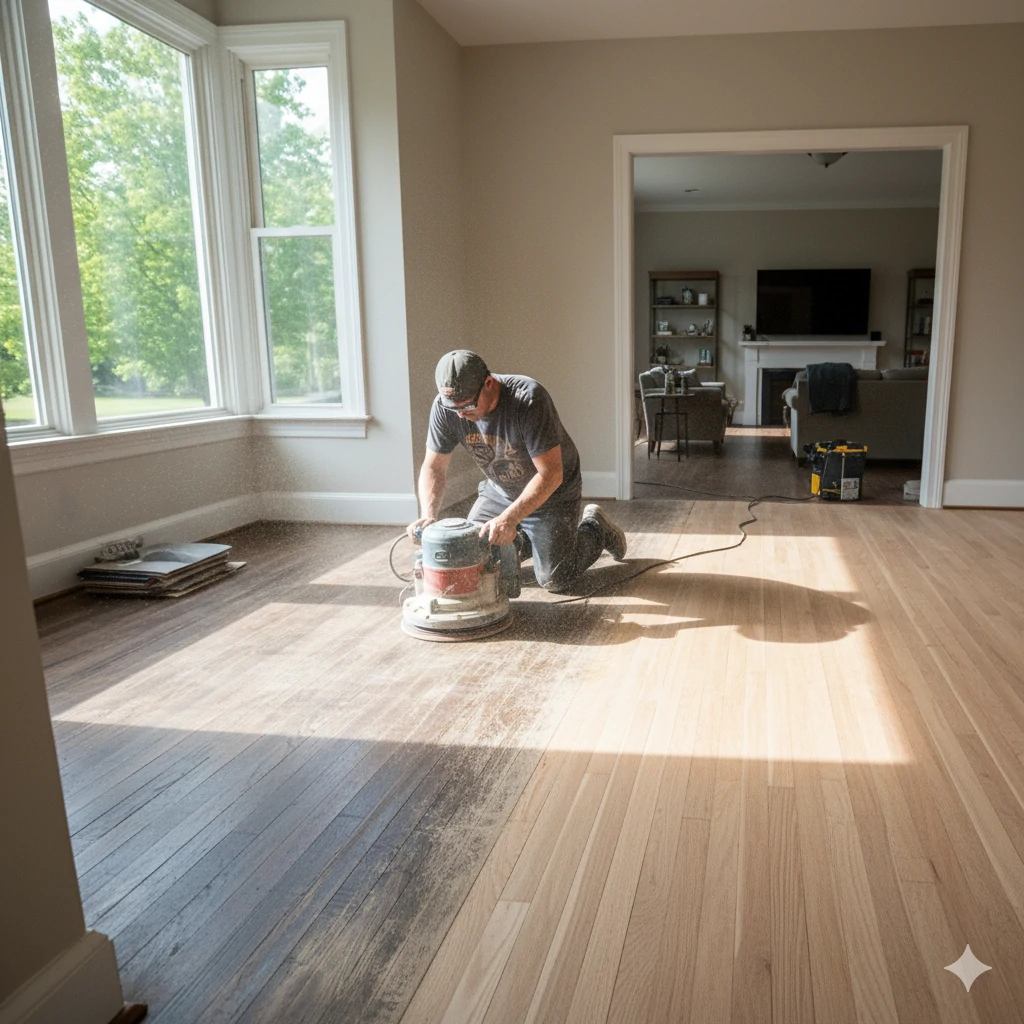
The most common thing we hear before a refinishing project: "We thought we needed to replace them." Most of the time, they do not. The floor itself is fine. The finish is not.
Refinishing sands the floor down to bare wood, removes every scratch and dull patch, and lays down fresh finish from nothing. The result looks like a new floor. It is not a new floor — it is the same floor that was already there, restored.
This page covers floor refinishing and sanding — assessment, sanding, stain selection, finish coats, and the cure time before you can move back in. We handle the project from start to final coat.
What Floor Refinishing and Sanding Covers for Brownsburg Homeowners
Here is how floor refinishing works in Brownsburg and when you can move back in:
- The crew sands the floor in multiple passes — coarse to fine grit — removing old finish and surface damage completely; a 1,000 square foot floor typically takes one full day
- Fine edge sanding is completed along walls and in corners that drum sanders cannot reach
- Stain is applied if a color change is requested and allowed to penetrate and dry fully before any finish coat goes down
- First finish coat is applied and lightly screened after drying; two to three coats total are standard for a durable result
- Final coat cures — water-based finishes are dry to light foot traffic in 24 hours; oil-based finishes require 48 to 72 hours minimum
- Furniture should not return for 72 hours minimum; rugs should stay off water-based finishes for at least two weeks
The floor must have enough solid wood above the tongue-and-groove to survive sanding. Each refinishing pass removes a small amount of material, and sanding too far exposes the groove, requiring full replacement. Brownsburg floor installation and refinishing experts measure remaining wear layer thickness before any work is scheduled. Many Brownsburg homes built in the 1990s have 3/4-inch solid hardwood that has never been refinished, typically allowing three to four sanding cycles before replacement becomes necessary.
What a professional refinishing project in Brownsburg covers:
Wood thickness assessment · Nail setting · Coarse sanding to bare wood · Medium and fine sanding passes · Edge sanding · Staining if selected · Multiple finish coats · Final cure management before furniture return
How Floor Refinishing Works From First Sanding Pass to Final Finish Coat
Most Brownsburg homeowners want two pieces of information before they book a refinishing project: how long will they be out of the rooms, and when can they move back in. Here is the honest answer to both.
Sanding day — the crew arrives with drum sanders, edge sanders, and detail tools. Sanding a standard-sized room takes most of a day. Multi-room projects or whole-home refinishing run one to two full days. The sanding phase is the loudest and dustiest phase. The crew seals off adjacent rooms and HVAC vents to contain dust. When they leave, the floor is bare, clean wood — no old finish, no stain, ready for color or clear finish.
Staining — if a color change is requested, stain goes on after the final fine sand pass. Stain needs to penetrate and dry fully before any finish coat goes down — typically two to four hours for most products. Applying finish over wet stain produces a blotchy, uneven color that cannot be fixed without sanding back to bare wood and starting over.
Finish coats — two to three coats are standard. First coat goes on after stain dries or directly after sanding on natural floors. Each coat is lightly screened after drying to remove dust nibs before the next coat goes on. The screening step takes a few minutes but produces a noticeably smoother finished surface than skipping it.
Cure windows:
Water-based finish — dry to light foot traffic in 24 hours; furniture can return after 72 hours; area rugs should stay off for at least two weeks because rugs trap off-gassing fumes that discolor and soften the finish. Oil-based finish — requires 48 to 72 hours for foot traffic, up to one week before furniture returns; longer cure but more durable and richer-looking than water-based in most applications.
Indiana's humidity levels affect finish cure times in Brownsburg homes. Water-based finishes cure faster but require stable indoor humidity during application. In Brownsburg's variable spring and fall seasons, we monitor conditions and adjust application timing to avoid finish clouding, bubbling, or slow cure that leads to premature wear.
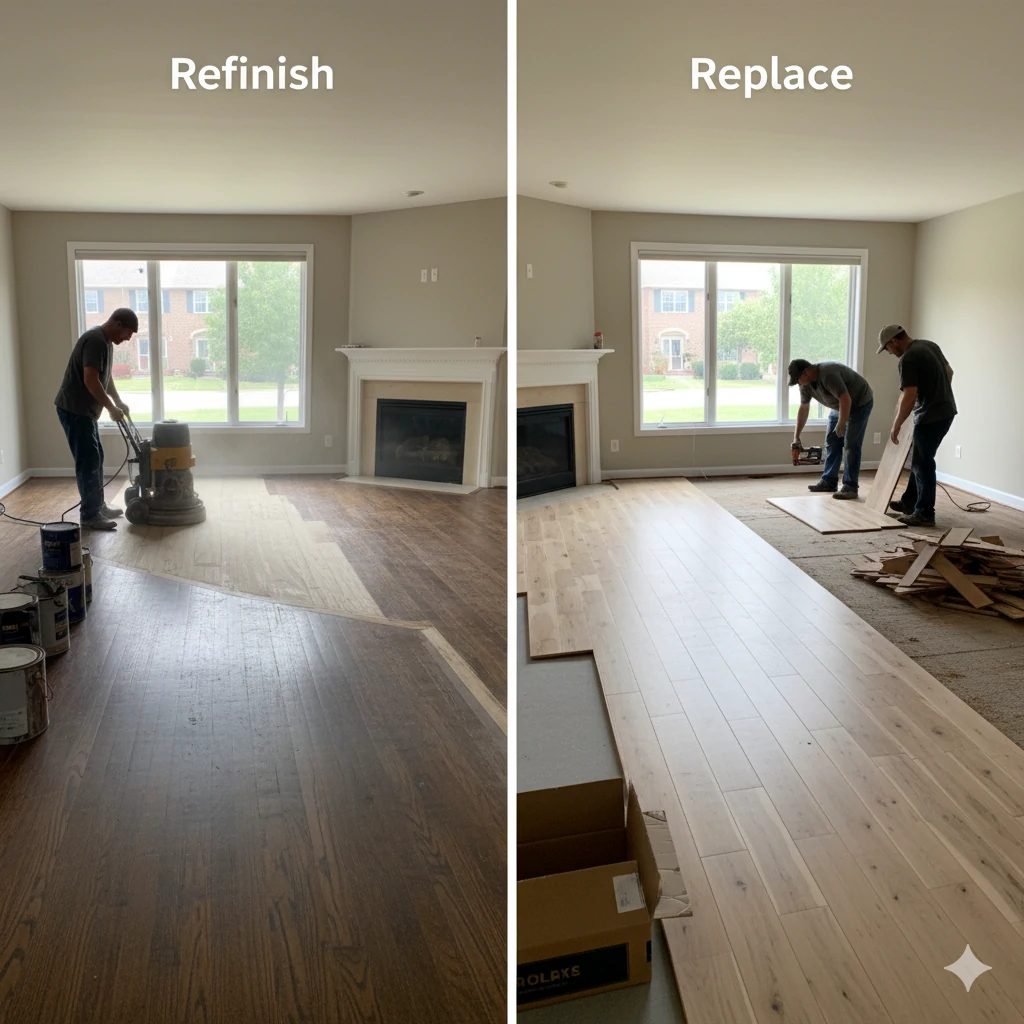
Refinish or Replace — Which Is the Right Call for Your Brownsburg Hardwood Floors
This is the question we get most often — and the honest answer is that most Brownsburg homeowners who think they need new floors do not.
Our general rule:
If the floor has adequate wood thickness remaining, no structural damage, and no widespread cupping or moisture damage, refinishing is the right call. It costs a fraction of replacement. It produces a like-new result. And in most Brownsburg homes from the 1990s and early 2000s, the floor qualifies.
When refinishing is the right call:
- Wood thickness is adequate — enough solid wood above the tongue-and-groove to survive sanding without exposing the groove
- No structural damage to individual boards — boards that are cracked, split, or deeply gouged can be replaced individually before refinishing
- No widespread cupping or crowning — cupped floors (edges higher than centers) or crowned floors (centers higher than edges) indicate a moisture problem; fixing the moisture source and allowing the floor to re-acclimate is required before refinishing; sanding a cupped floor flat removes too much wood from the edges
- The layout and species are right for the room — if the floor is the right material and the right layout, there is no reason to tear it out
When replacement makes more sense:
- Boards are too thin — previous refinishing has removed most of the wood above the groove; there is not enough left for another sand cycle
- Widespread structural damage — many boards are cracked, split, or have severe moisture damage that individual board replacement cannot address cost-effectively
- Layout change is needed — the existing floor layout does not match a new room configuration after a renovation
- Incompatible material — engineered hardwood that has been refinished to its limit; some thin-veneer engineered products cannot be refinished at all
Brownsburg's active real estate market makes floor condition a key factor in home presentation. Homeowners who refinish hardwood before listing consistently report that buyers respond well — and that the refinishing cost is returned at sale. It is one of the highest-return pre-listing projects available in Hendricks County.
Common Floor Refinishing Mistakes That Ruin Results in Brownsburg Homes
These failures come up in two ways — homeowners who call us after a refinishing job by someone else did not hold up, and conversations we have before projects where we explain why we do things in a specific sequence.
The most common refinishing failure in Brownsburg homes:
Finish applied over incompletely sanded floors where old finish residue remains in the wood grain. The new finish bonds to old finish rather than bare wood. That bond is weaker than a direct wood-to-finish bond. The floor looks great for a few months. Then it starts to peel — not because the new finish was bad, but because it was never bonded to the wood. The fix requires sanding back to bare wood and starting over. We sand to bare wood on every project, on every pass. Not as a quality upgrade. As the standard.
Other mistakes that ruin refinishing results:
- Skipping coarse sanding passes — old finish that is not fully removed in the coarse passes remains in the wood grain. Fine sanding smooths the surface but does not remove finish from the grain. The resulting floor looks smooth but has residue in the low spots that shows through the new finish.
- Uneven sanding that creates waves — a drum sander operated too quickly or with too much pressure in one area cuts the wood unevenly, creating a wavy surface that is visible across the room under raking light. Once the finish goes on, the waves are permanent.
- Applying finish in high humidity — water-based finish applied when indoor humidity is too high dries slowly, traps moisture in the film, and produces a cloudy or milky finish that cannot be corrected without sanding back down. We check indoor humidity before every finish coat.
- Too few finish coats — two coats of finish produce a floor that looks good on day one and shows wear within a year of normal traffic. Three coats are standard because the additional coat adds meaningful wear resistance without significant additional cost.
- Returning furniture before full cure — furniture placed on a floor before the finish has reached full hardness dents the finish and leaves marks that remain permanently. The cure window is not a suggestion. It is the time the finish needs to reach the hardness it was designed for.
Best Stain Colors and Finishes for Brownsburg Hardwood Floors in 2026
A refinishing project is the right time to think about whether the current stain color is still the one you want. Changing the stain costs very little relative to the total refinishing project — and it can completely change how a room feels.
What we are seeing in Brownsburg remodels in 2026: Natural and light warm tones are replacing the dark espresso and cool gray stains that were everywhere five years ago. Homeowners who stained their floors dark in 2018 or 2019 are now refinishing and going lighter. Matte and satin finishes are replacing high-gloss in almost every project we do.
Stain colors that are performing well in Brownsburg homes right now:
- Natural — no stain, just clear finish over the raw wood; shows the wood's natural color and grain; the most forgiving choice if you are not sure; always looks current
- Provincial — a warm medium brown that complements white oak and red oak equally; the most universally used stain in Hendricks County remodels for good reason; it does not fight any cabinet or trim color
- Warm walnut — deeper than provincial but not as dark as espresso; adds richness without making rooms feel heavy; works well in rooms with strong natural light
- Light gray or whitewash — works in contemporary and Scandinavian-influenced spaces; not the right call for traditional Brownsburg homes with stained trim and raised panel doors
Oak floors in established Brownsburg neighborhoods like Timber Creek and Country Brook respond best to natural, provincial, and warm walnut stains that enhance the wood's grain rather than masking it. Dark stains on red oak amplify the grain pattern in a way that does not always age well.
Finish type:
- Water-based polyurethane — cures faster, off-gases less, and dries to a clearer finish that shows the wood's natural color more accurately; requires two to three coats; the right choice for most Brownsburg homes
- Oil-based polyurethane — cures slower and has a stronger odor but produces a richer, amber-tinted finish that many homeowners prefer on traditional hardwood; more durable per coat but takes longer to cure before move-back
How to Prepare Your Brownsburg Home for Floor Refinishing and Sanding
A few things done before the crew arrives make the project start on time and finish with clean results.
The most important prep step:
Seal off HVAC vents in the rooms being sanded. Sanding produces a significant amount of very fine wood dust. If the HVAC is running during sanding, that dust gets distributed through the duct system and into every room in the house — including rooms that were not being refinished. Sealing vents in the work area is the most effective way to contain it.
What to have done before the crew arrives:
- All furniture removed from rooms being refinished — nothing can be in the room during sanding or finish application
- Area rugs removed and stored out of the space
- Floor registers removed and set aside — they need to come up before sanding begins
- Door thresholds removed if they are within the project scope — confirm with the remodeler before the project starts
- HVAC vents in work areas covered with plastic and tape — prevents dust migration through the duct system
- Pets and family members planned out of the home during sanding — for oil-based finish application, ventilation is needed but fumes are significant; for water-based, the off-gassing is lower but dust during sanding is still a concern for pets and people with respiratory sensitivities
- Windows managed carefully — Indiana's spring and fall outdoor humidity can cloud water-based finish if windows are opened during or immediately after application; your remodeler will advise on ventilation timing based on the outdoor conditions that day
Related Flooring Services in Brownsburg
Need new flooring instead of refinishing? See our full range of Brownsburg flooring contractor services:
- Hardwood floor installation — solid and engineered hardwood, subfloor prep through final finish
- LVP flooring installation — waterproof, durable planks for kitchens, bathrooms, and basements
- Tile floor installation — kitchens, baths, and entryways installed flat, level, and sealed
- Epoxy flooring — seamless, tough garage and basement floor coatings