
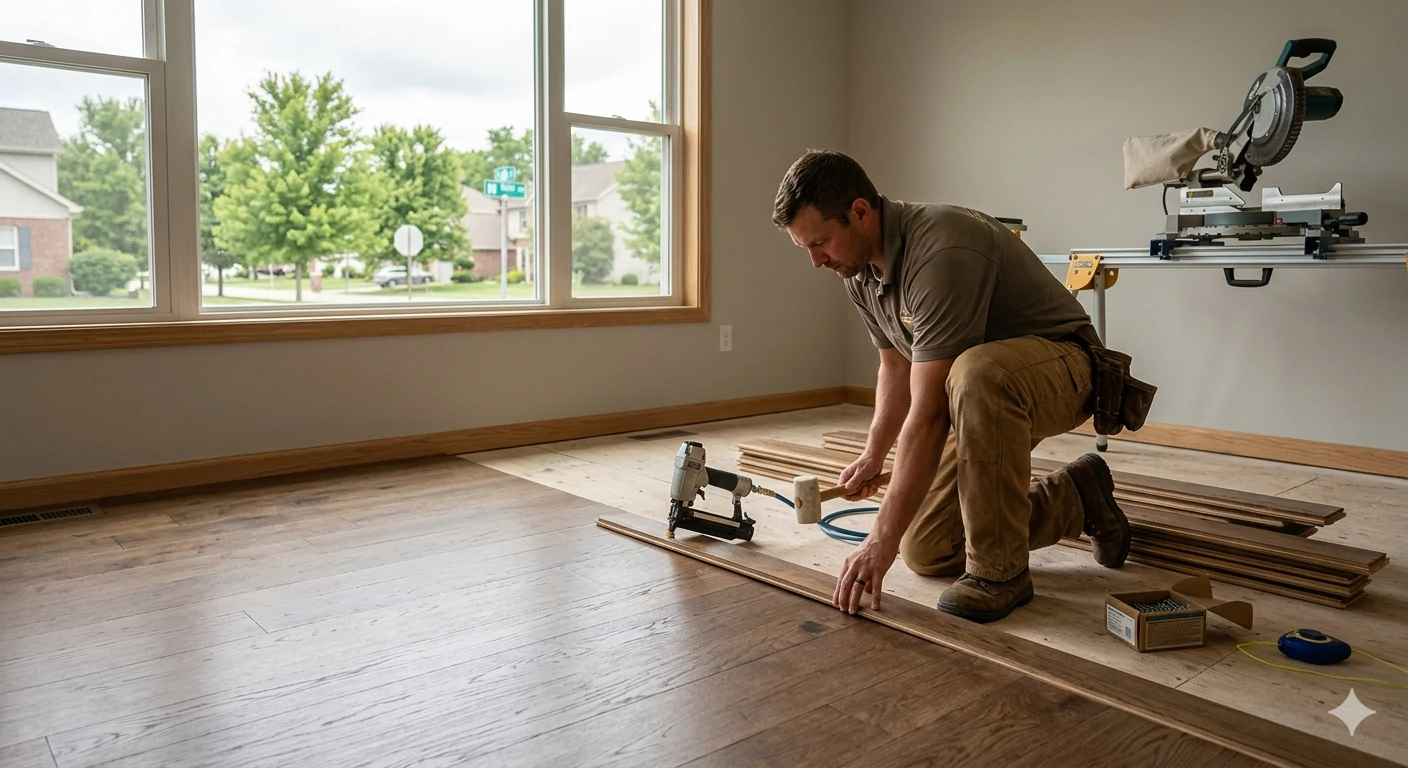
We have installed hardwood floors in Brownsburg homes where the installer before us skipped the moisture test. The floors looked great for six months. Then Indiana's summer humidity arrived. The planks swelled, the edges cupped, and gaps appeared at every joint. That is not a material failure. That is an installation failure — and it is entirely preventable when the work is done correctly.
This page covers hardwood floor installation — solid hardwood, engineered hardwood, species selection, finish options, and subfloor preparation. We handle your project from subfloor inspection through final sanding, finishing, and cleanup.
What Hardwood Floor Installation Covers for Brownsburg Homeowners
A professional hardwood floor installation is not just laying planks. Here is the full sequence — and which steps most commonly get skipped:
- The installer inspects the subfloor for levelness, moisture, and structural integrity before any material is ordered
- Hardwood is delivered and acclimated to your Brownsburg home's humidity level for three to seven days before installation begins
- The subfloor is repaired, leveled, and cleaned — no hardwood goes down over a compromised base
- Underlayment or moisture barrier is installed where required based on subfloor type
- Hardwood planks are laid, nailed or glued, and cut to fit walls, transitions, and doorways
- Floors are sanded smooth if unfinished; stain and finish coats are applied and cured
- Trim, thresholds, and transitions are installed and a final walkthrough confirms quality
Brownsburg's seasonal humidity swings — from dry Indiana winters to humid summers — make proper hardwood acclimation and moisture management critical. A Brownsburg flooring contractor accounts for these conditions before the first plank is installed, ensuring subfloor and material stability. Big-box installers often skip these steps, which increases the risk of gaps, cupping, or movement over time.
What a professional hardwood installation in Brownsburg covers:
Subfloor inspection · Material acclimation · Subfloor preparation · Moisture barrier or underlayment · Plank installation · Sanding and finishing for unfinished hardwood · Staining if selected · Trim, transitions, and thresholds
How Hardwood Floor Installation Works From Subfloor to Final Finish
Most homeowners focus on the floor they can see. The work that determines whether that floor lasts happens underneath it and before installation begins.
Indiana subfloor moisture challenges cause premature floor failure. We test subfloor moisture content before every installation and address any readings above manufacturer tolerances before a single plank goes down. This is a step big-box installers routinely skip — and the floor failures we get called to assess almost always trace back to it.
Here is what each phase of a Brownsburg hardwood installation looks like:
- Subfloor inspection — moisture meter readings taken at multiple locations; any reading above the product's allowable threshold is addressed before the project continues; levelness confirmed to within manufacturer specifications
- Acclimation — hardwood delivered to the home and stored in the rooms where it will be installed for three to seven days; the wood reaches equilibrium with the indoor humidity before it is cut
- Subfloor prep — high spots ground down, low spots filled, squeaks addressed, any damaged sections replaced; the surface has to be flat and dry before underlayment goes down
- Underlayment or moisture barrier — required over concrete subfloors and recommended in crawl space homes; protects the wood from moisture migration from below
- Installation — planks laid from the straightest wall in the room, nailed or glued based on the product and subfloor type; expansion gaps maintained at all walls and transitions
- Sanding — for unfinished hardwood, three or more passes with progressively finer grits produce a flat, smooth surface; edges and corners hand-sanded to match the main field
- Staining — applied and allowed to dry fully before any finish coats; stain that is sealed before it dries produces blotchy, uneven color
- Finishing — two to three coats of polyurethane, oil, or hardwax finish with cure time between each coat; the final coat is not walked on until it has reached full hardness
- Trim and transitions — base shoe or quarter round reinstalled at walls, thresholds set at doorways, transitions to tile, carpet, or other flooring types installed and secured
Best Hardwood Species and Colors for Brownsburg Homes in 2026
This is the question most Brownsburg homeowners spend the most time on — and the one where having a local perspective actually matters.
Our most consistent recommendation for Brownsburg homes in 2026:
White oak in a natural or lightly stained finish, wide planks, matte sheen. It handles Indiana's humidity fluctuations better than many species, it stains evenly, and it has been the most requested choice in Hendricks County remodels for the past several years without showing any sign of dating quickly.
Brownsburg has two distinct aesthetic contexts — 1990s traditional homes with stained trim and more formal layouts, and newer construction with lighter, more open floor plans. The right species and stain depends on which type of home you have, what your trim colors are, and how much natural light the rooms get.
Species worth knowing about for Brownsburg homes:
- White oak — neutral, consistent grain; stains beautifully from light natural to medium brown; handles moisture better than red oak; the most versatile choice for Hendricks County homes in 2026
- Red oak — traditional look with visible grain; takes stain less evenly than white oak; still a solid choice for traditional homes in Timber Creek and similar neighborhoods where the existing trim and aesthetic already lean toward classic
- Hickory — dramatic grain variation; very hard and durable; works well in homes where character is the priority; harder to match if repairs are ever needed
- Maple — very light, subtle grain; takes stain unevenly; best left in a natural or whitewashed finish; good choice for contemporary or Scandinavian-influenced spaces
Finish and color direction for 2026 Brownsburg remodels:
- Light natural tones and warm whites are replacing the cool grays that dominated a few years ago
- Matte and satin sheens are replacing high gloss in most Brownsburg renovation projects — they show less footprint traffic and look more natural underfoot
- Wide planks (five inches and above) read more contemporary; narrower strips suit traditional Brownsburg home styles better
Solid Hardwood vs. Engineered Hardwood — Which Is Right for Your Brownsburg Home
Both are real wood. The difference is in how they are constructed and where they can go.
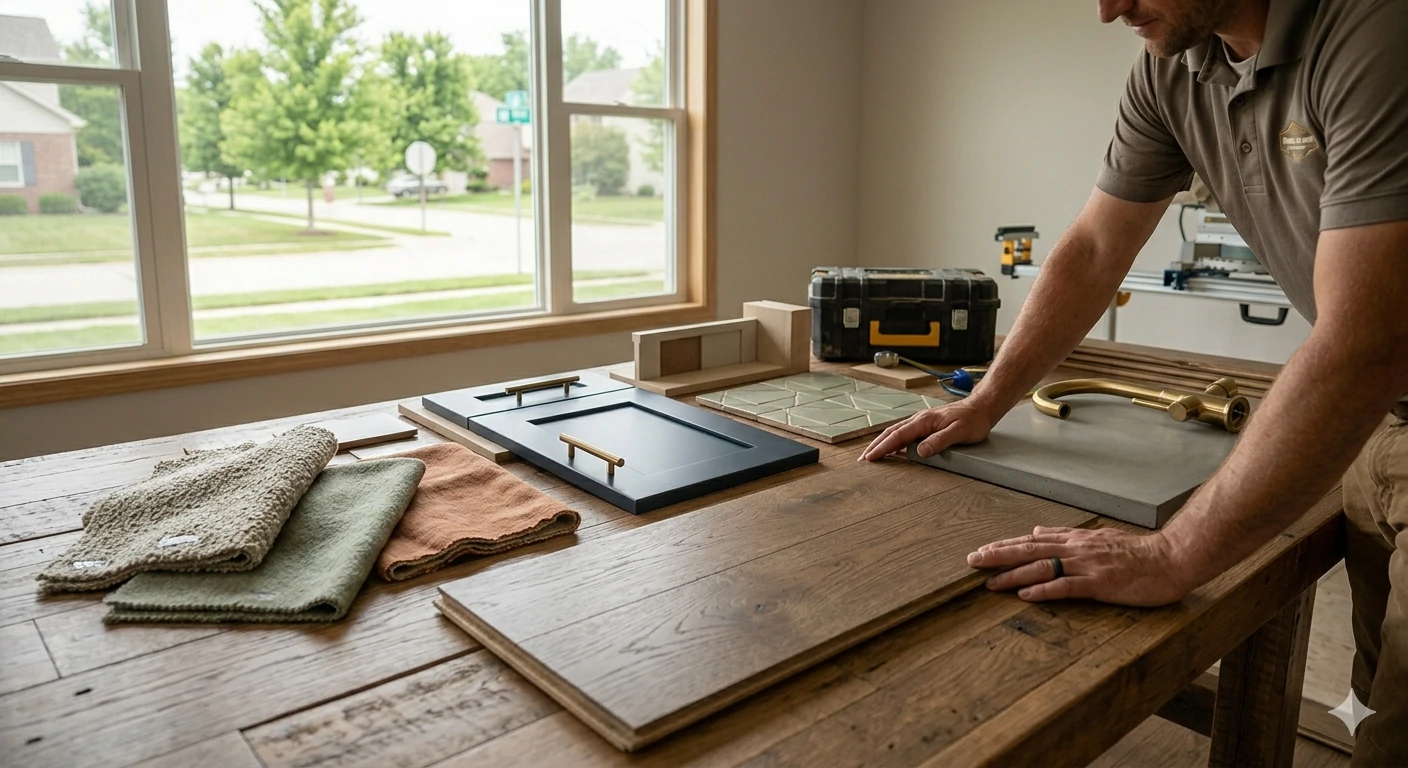
Solid hardwood is a single piece of wood from top to bottom. It can be sanded and refinished multiple times over its life — a genuine advantage in a home where the floor is expected to last fifty or more years. It is sensitive to moisture and temperature swings. In Indiana's climate, it needs to be installed over a wood subfloor above grade. It cannot go over concrete or in below-grade spaces.
Engineered hardwood has a real hardwood veneer on top of a layered plywood core. The layered core is dimensionally stable — it does not expand and contract with humidity changes the way solid wood does. It can be installed over concrete subfloors. It can go in basements. It can go in kitchens and mudrooms where moisture is higher than in a bedroom. It can be refinished, though fewer times than solid wood.
Our honest take on this question:
For Brownsburg homes on slab foundations or with basement spaces, engineered hardwood is the correct product — not a compromise. Solid hardwood installed in those conditions will cup, gap, and fail in Indiana's seasonal moisture cycle. For second-floor bedrooms and main-floor living areas over wood subfloors, solid is an excellent choice and the long refinishing timeline is a genuine advantage.
How to decide:
- Over concrete subfloor: engineered only
- Below grade in a basement: engineered only
- First floor over wood subfloor: either; engineered handles humidity swings slightly better
- Second floor: either; solid is a strong choice here and will refinish more times over the life of the home
- Kitchen or mudroom: engineered; higher moisture exposure makes solid a risk
What Affects the Scope and Timeline of Hardwood Installation in Brownsburg
Most hardwood floor projects in Brownsburg run three to seven days. Here is what moves the timeline in each direction.
What makes a project faster:
- Prefinished hardwood — already sanded and finished at the factory; no on-site sanding or finish coats needed; can be walked on immediately after installation
- Small square footage with simple layouts — fewer rooms, fewer transitions, less time
- Good subfloor condition — flat, dry, and sound; no repairs needed before installation
What adds time:
- Unfinished hardwood requiring on-site sanding and finishing — adds two to three days for sanding, staining, and two to three finish coats with cure time between each
- Subfloor repairs — leveling, replacing damaged sections, or addressing moisture issues before installation adds time and sometimes adds cost
- Large or complex layouts — multiple rooms, custom borders, diagonal installations, or herringbone patterns all take longer
- Acclimation period — three to seven days where the wood is in the home before installation; not construction time, but it is time on the project calendar
Booking advice for Brownsburg homeowners: peak flooring season runs spring through fall when home sales and renovation activity peak in Hendricks County. Booking early avoids scheduling delays. And scheduling before Indiana's humid summer months gives hardwood the best acclimation conditions — lower indoor humidity in late winter and spring creates ideal conditions for wood to acclimate before it is cut and installed.
How to Prepare Your Brownsburg Home for Hardwood Floor Installation
A few things done before the crew arrives make the installation start on time and go smoothly from day one.
The preparation step most Brownsburg homeowners forget:
Running the HVAC before and during installation to stabilize indoor humidity. Hardwood acclimated to a home where the heat has been off for the weekend and indoor humidity is uncontrolled is not properly acclimated. The HVAC should be at its normal operating temperature and humidity for at least 24 to 48 hours before delivery and throughout the acclimation period.
What to have done before installation day:
- All furniture removed from installation areas — the crew cannot install around furniture; everything needs to be out of the rooms before they arrive
- Existing flooring removed if not included in the contract scope — confirm this before the project starts; some installations include flooring removal and some do not
- Subfloor soft spots or squeaks communicated to the installer before the project begins — flagging these in advance allows the crew to plan for subfloor repair materials and time
- HVAC running at normal operating conditions — indoor humidity stabilized for at least 24 to 48 hours before hardwood delivery
- Plan for finish cure time — after the final finish coat, the floor should not have furniture placed on it for at least 24 to 72 hours depending on the finish type; plan where furniture will be during this period
Brownsburg homes in crawl space neighborhoods like Timber Creek and Eagle Pines should have crawl space humidity checked before hardwood installation. Elevated crawl space moisture migrates through subfloors and causes hardwood to cup if it is not addressed before the floor goes down. We check this during the site assessment.
Related Flooring Services in Brownsburg
Looking for a different flooring product or need your existing floors restored? See our full range of Brownsburg flooring services:
- LVP flooring installation — waterproof, durable planks for kitchens, bathrooms, and basements
- Tile floor installation — kitchens, baths, and entryways installed flat, level, and sealed
- Floor refinishing and sanding — restore worn hardwood to like-new condition
- Epoxy flooring — seamless, tough garage and basement floor coatings